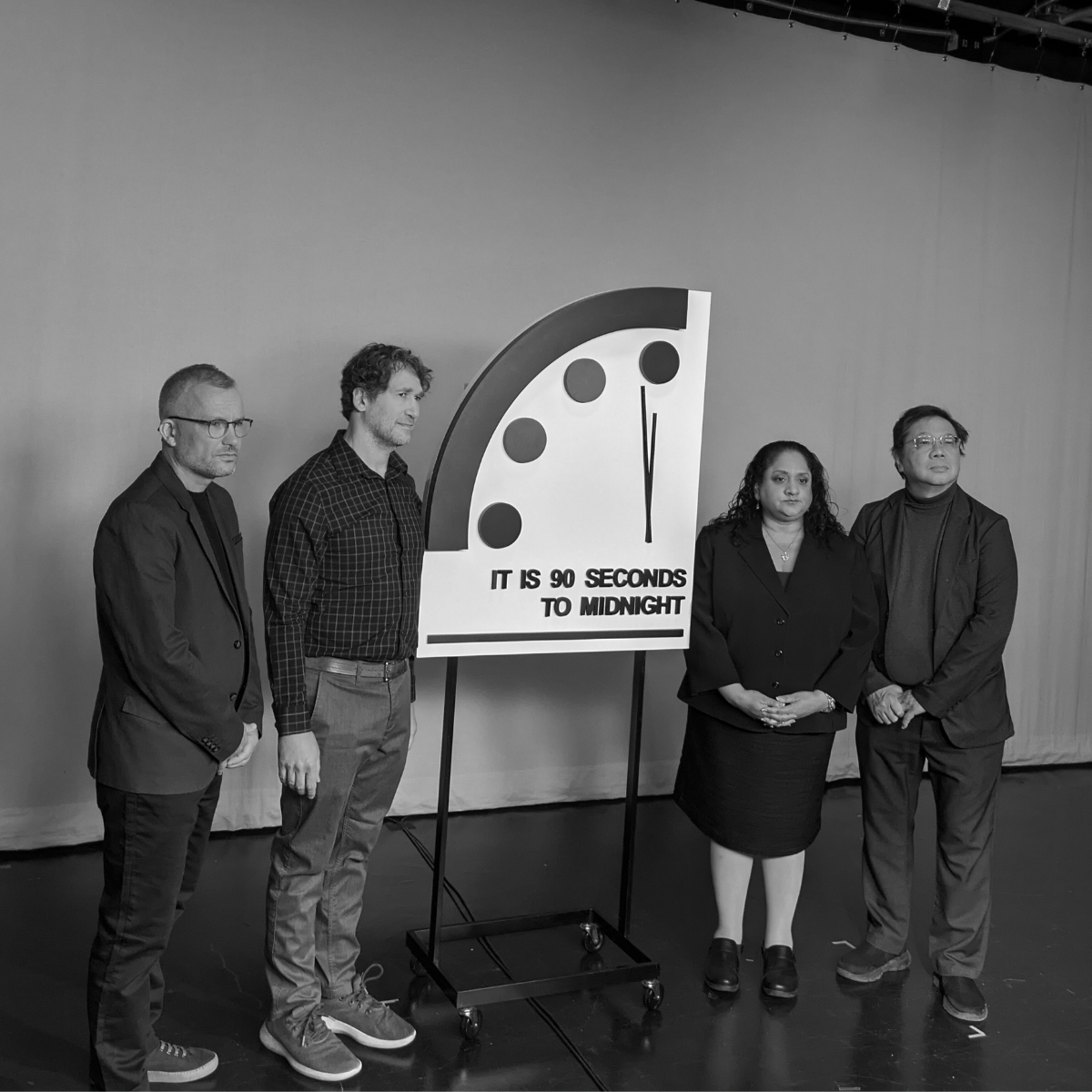
The Doomsday Clock 2026 has been reset to 85 seconds to midnight, officially marking the most dangerous moment in human history. The announcement was made on January 27, 2026, by the Bulletin of the Atomic Scientists, a global body of leading experts that tracks threats capable of ending civilization.
This update signals that the world is now closer to self-destruction than at any point during the Cold War, World War II aftermath, or even the nuclear standoff of the 1960s.
But what exactly pushed scientists to this alarming conclusion—and what does it truly mean?
What Is the Doomsday Clock? (Complete Explanation)
The Doomsday Clock is a symbolic clock created in 1947 by atomic scientists involved in the Manhattan Project. Its purpose is to visually represent how close humanity is to global catastrophe caused by its own actions.
- Midnight represents total global disaster
- Minutes or seconds before midnight indicate the level of danger
- The closer the clock moves, the greater the risk
It is not a countdown, prediction, or prophecy. Instead, it is a scientific communication tool designed to warn governments, institutions, and citizens.
Who Controls and Decides the Doomsday Clock Time?
The clock is set annually by the Bulletin of the Atomic Scientists, headquartered at the University of Chicago.
Their decision-making panel includes:
- Nobel Prize winners
- Nuclear physicists
- Climate scientists
- AI researchers
- Former diplomats and security experts
Notably, Albert Einstein served on the Bulletin’s Board of Sponsors during its early years.
Doomsday Clock 2026: What Is the New Time?
➡️ 85 seconds to midnight
This is:
- The closest setting ever
- Closer than 2025’s 89 seconds
- A sharper warning than during the Cold War’s peak
For context, during the Cuban Missile Crisis, the clock never moved this close.
Why Did the Doomsday Clock Move Forward in 2026?
Scientists cited five interlinked existential threats, all worsening at the same time.
1. Nuclear Weapons: A World Without Guardrails
One of the biggest triggers for the 2026 update is the expiration of the New START Treaty on February 5, 2026.
- It was the last remaining nuclear arms control agreement between the US and Russia
- No replacement treaty is currently in place
- Major nuclear powers are modernizing arsenals
- Communication channels are weakening
Experts warn that the risk today is not intentional nuclear war—but miscalculation, escalation, or accident.
2. Wars and Geopolitical Instability
Ongoing and expanding conflicts across:
- Eastern Europe
- Middle East
- Global maritime routes
have increased:
- Military spending
- Proxy warfare
- Use of autonomous drones and cyber weapons
Diplomacy is being replaced by force-first strategies, increasing the chance of global spillover.
3. Climate Change Reaching Irreversible Tipping Points
2025 was among the hottest years on record, with:
- Extreme heatwaves
- Historic floods
- Uncontrollable wildfires
- Melting glaciers and rising sea levels
Scientists warn that the 1.5°C global warming limit is dangerously close to being breached permanently.
Climate change is now viewed as a threat multiplier, intensifying conflicts, food insecurity, migration, and disease.
4. Artificial Intelligence Without Global Rules
For the first time, AI risk played a central role in pushing the clock forward.
Key concerns include:
- AI-controlled weapons systems
- Autonomous military decision-making
- Deepfake misinformation influencing elections
- Cyber attacks powered by machine learning
The Bulletin warned that AI is advancing faster than laws, ethics, or global governance.
5. Biological & Pandemic Threats
Despite COVID-19 lessons:
- Global pandemic preparedness remains weak
- Bioengineering tools are becoming more accessible
- Lab safety oversight varies widely across countries
Scientists fear a future outbreak could be deadlier and faster-spreading.
Has the Doomsday Clock Ever Been This Close Before?
No. This is unprecedented.
Doomsday Clock Timeline (Key Years)
| Year | Time Set | Global Context |
|---|---|---|
| 1991 | 17 Minutes | End of the Cold War (Safest Point) |
| 2020 | 100 Seconds | Climate change and misinformation risks |
| 2025 | 89 Seconds | Wars in Ukraine and Gaza |
| 2026 | 85 Seconds | Nuclear escalation, AI risks, climate crisis |
What Does 85 Seconds to Midnight Actually Mean?
It does not mean the world will end in 85 seconds.
It means:
- Risks are extremely high
- Systems meant to protect humanity are failing
- Decision-makers are running out of margin for error
The Bulletin emphasizes:
👉 Human choices—not fate—determine the clock’s movement.
India’s Relevance in the Doomsday Clock 2026 Context
India plays a crucial role because:
- It is a nuclear-armed nation
- One of the most climate-vulnerable countries
- A rising AI and technology hub
- An important diplomatic bridge between global powers
Experts believe India’s leadership in renewable energy, global health, and diplomacy could help stabilize future risk.
Can the Doomsday Clock Be Turned Back?
Yes—and it has happened before.
Bulletin’s Key Recommendations for 2027
- Restart nuclear arms control negotiations
- Establish global AI governance treaties
- Rapid fossil-fuel phase-out
- Strengthen international institutions
- Improve pandemic preparedness systems
Is the Doomsday Clock Criticized?
Yes. Critics argue:
- It is symbolic, not mathematical
- It may create fear
Supporters counter that:
- It simplifies complex risks
- Keeps existential threats visible
- Forces accountability from leaders
People Also Ask
Is the Doomsday Clock real or symbolic?
It is symbolic but based on real scientific assessments.
Who created the Doomsday Clock?
Scientists involved in the Manhattan Project in 1947.
What is the closest the clock has ever been?
85 seconds to midnight in 2026.
Final Conclusion: A Warning the World Cannot Ignore
The Doomsday Clock 2026 update is not about fear—it is about urgency.
It reflects a world where:
- Technology is outrunning ethics
- Climate damage is accelerating
- Nuclear safeguards are disappearing
Yet, the message remains hopeful:
🕊️ The clock can still be turned back—if humanity chooses cooperation over conflict.
About The Author