The Bhagavad Gita Chapter 12 Source- AI
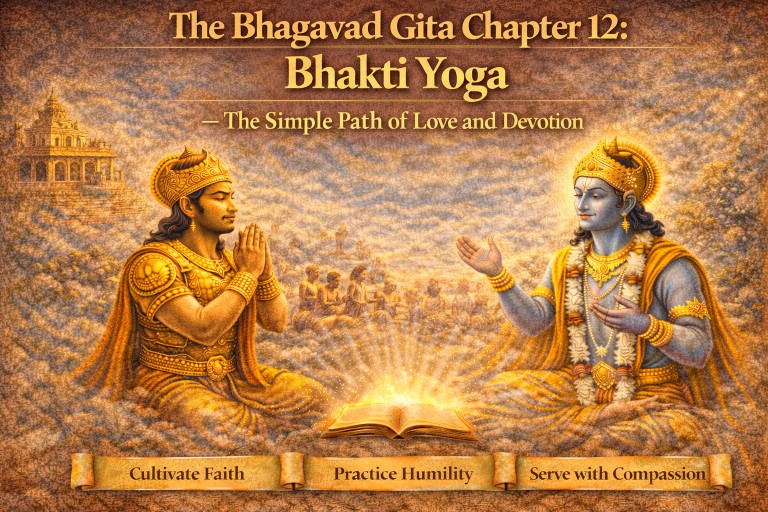
Chapter 12 of the Bhagavad Gita is called Bhakti Yoga, the yoga of love and devotion. In this chapter, Arjuna asks a very important question: Who is better, the one who worships God in a personal form, or the one who meditates on the formless Absolute?
Krishna’s answer makes this chapter one of the most loved and comforting parts of the Gita.
Personal Devotion Is Easier for Most People
Krishna explains that both paths, worship of the formless and worship of God with form, lead to the same truth. However, for most people, devotion to God with a form is easier and more natural. The human mind finds it difficult to focus on something abstract and formless.
That is why Krishna lovingly encourages the path of bhakti.
Fix the Mind on God
Krishna says that those who fix their mind and heart on him, worship him with faith, and remain dedicated are very dear to him. Even if someone finds it hard to meditate constantly, Krishna gives simple alternatives:
- Practice remembering God again and again
- Offer all actions to God
- Work with devotion, without attachment to results
Step by step, the mind becomes purified.
God Helps His Devotees
One of the most reassuring teachings of this chapter is Krishna’s promise:
He personally attends to the needs of his devotees. Those who surrender their worries and trust him are protected from fear and suffering.
This teaching brings great comfort to anyone feeling anxious or lost.
Qualities of a True Devotee
Krishna then describes the qualities of a devotee who is dear to him. Such a person:
- Is kind and friendly to all
- Has no hatred or ego
- Is patient and forgiving
- Remains calm in happiness and sorrow
- Is content and self-controlled
- Is not disturbed by praise or criticism
These qualities show that bhakti is not just prayer, it is a way of living.
Love Without Conditions
A true devotee does not love God for rewards. Their devotion is pure and unconditional. They do not demand success, wealth, or comfort. They trust God’s will and remain steady in all situations.
Krishna says such devotees are extremely dear to him.
Bhakti Is for Everyone
Bhakti Yoga is open to all people, regardless of background, education, or status. It does not require complex rituals or deep philosophy. A sincere heart and loving faith are enough.
Even small acts, like remembering God, offering food with love, or speaking his name, carry great spiritual power.
A Practical Path for Daily Life
Bhakti Yoga fits easily into daily life. One does not need to leave home or responsibilities. By offering work, thoughts, and emotions to God, everyday life becomes a spiritual practice.
This makes Bhakti Yoga especially meaningful in the modern world.
The Highest Teaching of Love
Krishna concludes by saying that those who follow this path of devotion with faith are very dear to him. Such souls reach him and experience eternal peace.
Conclusion
The Bhagavad Gita Chapter 12, Bhakti Yoga, teaches that love is the strongest spiritual force. Through devotion, surrender, and trust, anyone can connect with God.
This chapter reminds us that God does not look at our abilities or achievements; He looks at our hearts. A life filled with love, compassion, and devotion leads to true happiness and liberation.
Disclaimer:
This content is for general informational purposes about spiritual teachings in India and worldwide. It is not professional or personal advice. For guidance, consult authentic sources or qualified spiritual teachers.
About The Author