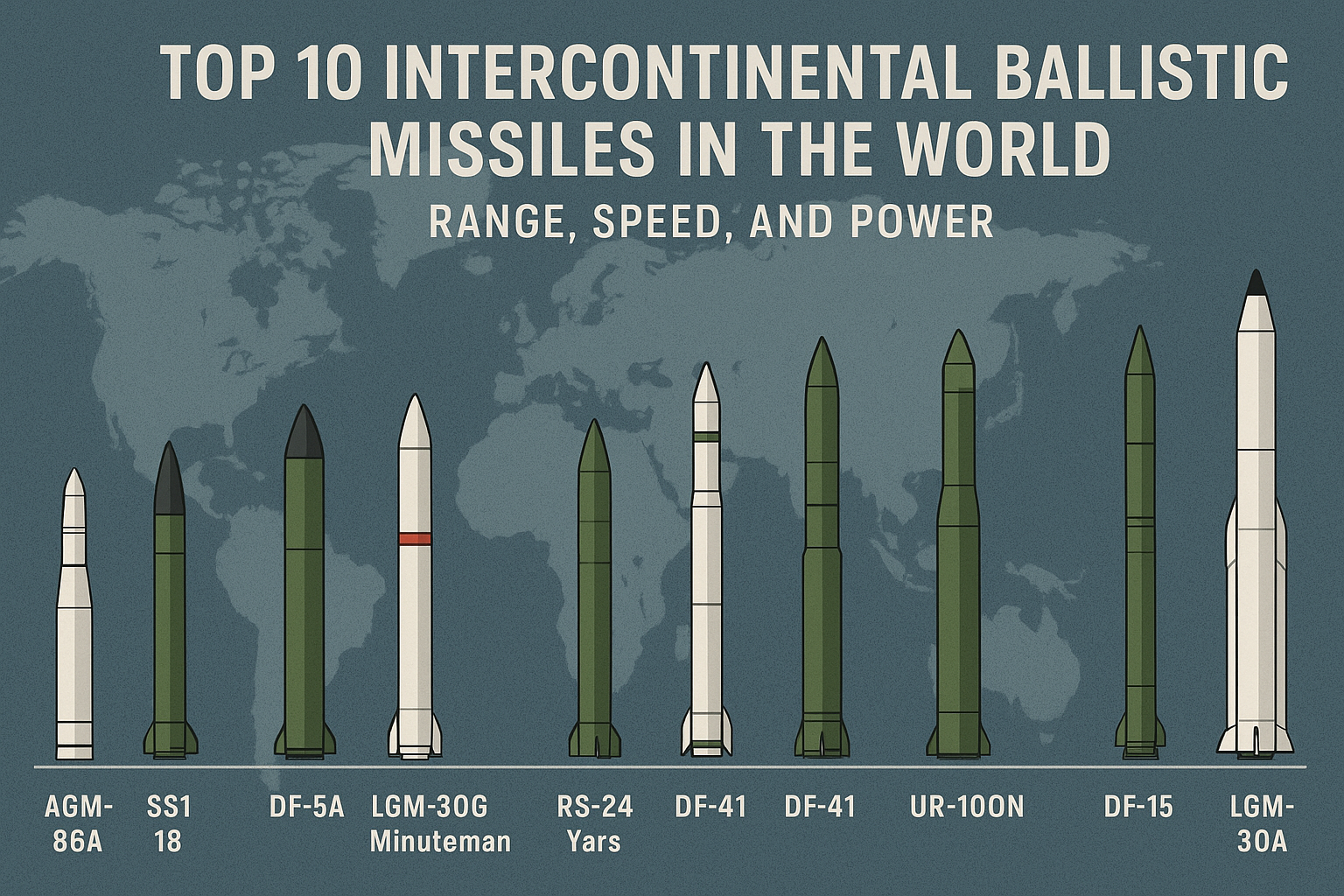
Top 10 Intercontinental Ballistic Missiles in the World
Intercontinental Ballistic Missiles (ICBMs) are among the most powerful weapons in modern military arsenals. Designed to travel thousands of miles across continents, ICBMs carry nuclear warheads and play a crucial role in global deterrence strategies. Their range, speed, and precision make them a formidable force, able to strike with devastating force anywhere on the planet within hours.
In this article, we will explore the Top 10 Intercontinental Ballistic Missiles (ICBMs), detailing their range, speed, and overall capabilities, and how these weapons contribute to global military power.
1. LGM-30 Minuteman III (United States)
Range: 13,000 km
Speed: Mach 24 (about 29,000 km/h)
The LGM-30 Minuteman III is the United States’ primary ICBM, and it’s been in service since 1970. This missile is silo-launched and has an impressive range of around 13,000 kilometers. The Minuteman III is capable of carrying multiple independently targetable reentry vehicles (MIRVs), allowing it to strike multiple targets in one launch.
In terms of speed, the Minuteman III reaches speeds of Mach 24, making it capable of delivering its payload anywhere in the world within 30 minutes. While it’s being gradually replaced by more advanced systems, it remains a cornerstone of U.S. nuclear deterrence.
2. RS-28 Sarmat (Russia)
Range: 18,000 km
Speed: Mach 20
The RS-28 Sarmat, known by NATO as the “Satan 2,” is Russia’s latest and most powerful ICBM. It is designed to replace the older R-36M2 Voyevoda missile and has been touted as capable of reaching ranges of up to 18,000 km. This missile can carry up to 15 MIRVs, which makes it incredibly difficult to defend against.
At a speed of Mach 20, it is one of the fastest ICBMs in the world. The Sarmat is equipped to penetrate missile defense systems with a variety of countermeasures and can target both military and civilian locations with extreme accuracy.
3. DF-41 (China)
Range: 12,000-15,000 km
Speed: Mach 25
The DF-41 is China’s most advanced ICBM and represents a significant leap in its missile technology. It has a range between 12,000 and 15,000 kilometers, which makes it capable of reaching nearly all major cities in the United States, Europe, and Russia.
With a speed of Mach 25, the DF-41 can travel at extreme speeds, giving little time for defense systems to intercept. Additionally, it can carry up to 10 MIRVs, each targeting a different location, further enhancing its destructive power.
4. R-36M2 Voyevoda (Russia)
Range: 16,000 km
Speed: Mach 20
The R-36M2 Voyevoda, also known as the SS-18 Satan, was once considered the most powerful ICBM in the world. It was designed during the Soviet era and remains in service as a part of Russia’s nuclear deterrent. With a range of 16,000 kilometers, it has the ability to target any location on Earth, and it can carry 10 MIRVs.
Despite being an older missile, the R-36M2 still holds a reputation for its sheer size and power. Its speed of Mach 20 and the MIRVs it carries make it a highly formidable weapon in Russia’s nuclear arsenal.
5. Agni-V (India)
Range: 5,000-8,000 km
Speed: Mach 24
India’s Agni-V is one of the most advanced ICBMs in Asia. With a range of 5,000 to 8,000 kilometers, it can target most locations in China, Pakistan, and parts of Europe. The Agni-V is known for its ability to carry a single nuclear warhead or multiple MIRVs, which provides flexibility in strategic targeting.
Reaching speeds of Mach 24, the Agni-V can strike swiftly and with great precision. India’s investment in the Agni series of missiles has solidified its position as a key player in nuclear deterrence in the region.
6. Hwasong-15 (North Korea)
Range: 13,000 km
Speed: Mach 22
North Korea’s Hwasong-15 ICBM was tested in 2017, and while its exact specifications remain a closely guarded secret, it is estimated to have a range of 13,000 kilometers. This missile can potentially strike the entire U.S. mainland, especially with its nuclear payload.
The Hwasong-15 is capable of reaching speeds of Mach 22, making it a serious threat to missile defense systems. Although the missile’s operational status is unclear, its testing has marked a significant advancement in North Korea’s missile technology.
7. Trident II D5 (United States)
Range: 12,000 km
Speed: Mach 24
The Trident II D5 is a submarine-launched ballistic missile (SLBM) and is one of the most reliable and accurate nuclear missiles in the U.S. arsenal. With a range of 12,000 kilometers, the Trident II D5 can strike targets on nearly every continent, with its strategic advantage being its launch from a submerged submarine, making it harder to detect.
At a speed of Mach 24, it can deliver its payload with precision and swiftness. It is deployed aboard Ohio-class submarines and forms a crucial part of the U.S. nuclear triad.
8. M51 (France)
Range: 8,000 km
Speed: Mach 25
The M51 is France’s next-generation submarine-launched ballistic missile. With a range of 8,000 kilometers, the M51 can reach nearly any part of Europe, Asia, and the Americas. This missile is equipped with multiple MIRVs, allowing it to target several locations simultaneously.
At a top speed of Mach 25, the M51 is one of the fastest ICBMs in service today. It is deployed aboard France’s nuclear-powered submarines and is an integral part of its nuclear deterrence strategy.
9. LORA (Israel)
Range: 400 km
Speed: Mach 3.5
While not technically an ICBM, LORA (Long Range Artillery) is Israel’s advanced missile system that bridges the gap between tactical and strategic missile systems. With a range of 400 kilometers, the LORA can deliver both conventional and nuclear payloads, but it is typically used for more localized strikes.
The missile is capable of speeds up to Mach 3.5 and is primarily used for tactical operations but can potentially be used for strategic deterrence.
10. Dong Feng-5B (China)
Range: 13,000 km
Speed: Mach 25
China’s Dong Feng-5B is a liquid-fueled ICBM that has been in service for decades. With a range of approximately 13,000 kilometers, it can reach targets across continents. It is capable of carrying multiple warheads, enhancing its lethality and effectiveness.
The Dong Feng-5B travels at speeds of Mach 25 and can penetrate advanced missile defense systems with its high-speed trajectory and MIRV capabilities.
Conclusion
ICBMs represent the pinnacle of strategic military power and deterrence, with their ability to travel vast distances at incredible speeds, carrying nuclear payloads that could change the course of history. The Top 10 Intercontinental Ballistic Missiles highlighted in this article showcase the capabilities and advancements in missile technology that define modern nuclear deterrence.
These ICBMs, each with their own unique features and strategic importance, play a central role in the defense and military strategies of their respective countries. As the technology continues to evolve, the race for missile advancement and missile defense systems remains a key factor in global military geopolitics.
About The Author