Who Wrote the Vedas_ History, Myths, and Facts- All You Need to Know
When people first hear about the Vedas, one of the most natural questions is also the simplest: Who wrote them?
We’re used to books having authors. A name. A face. A time and place.
The Vedas don’t work that way—and that’s where the story becomes interesting.
The short answer is: no single person wrote the Vedas.
The longer, more human answer takes us into a world of memory, myth, listening, and lived experience.
Let’s walk through it slowly.
Why This Question Comes Up So Often
The Vedas are among the oldest surviving texts in human history. Whenever something lasts that long, curiosity follows.
People wonder:
- Were the Vedas written by sages or scholars?
- Are they divine revelations?
- Are they historical documents or spiritual poetry?
- How could anyone remember so much without writing it down?
These questions don’t come from doubt alone. They come from genuine wonder.
The Traditional Belief: “Heard, Not Written”
In the traditional Indian understanding, the Vedas were not written by humans in the usual sense.
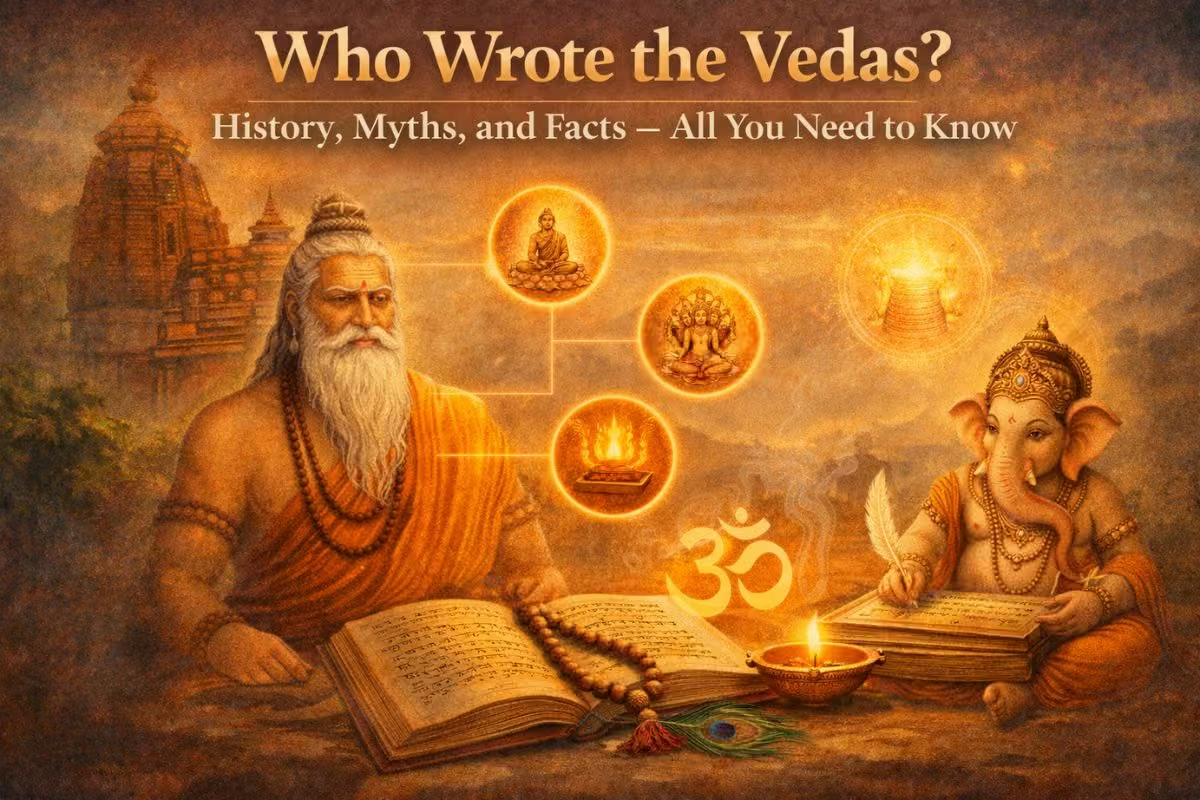
They are described as apauruṣeya, a Sanskrit term meaning “not of human authorship.” According to this view, ancient sages—called rishis—did not invent the Vedas. They heard them.
These sages were seen as deep listeners. Through intense observation, meditation, and reflection, they perceived truths about life and the universe. What they “heard” was then passed on—word for word, sound for sound.
In this tradition, the rishis are not authors. They are seers.
The Historical View: How Scholars Understand It
From a historical perspective, most scholars agree on a few key points:
- The Vedas were composed over many centuries, roughly between 1500 BCE and 500 BCE
- They were created by many voices, not one mind
- They evolved gradually as ideas were added, refined, and reorganized
Rather than being written in one moment, the Vedas grew slowly—shaped by generations of people observing nature, society, rituals, and inner life.
This doesn’t make them less meaningful. If anything, it makes them more human.
Who Were the Rishis, Really?
The word rishi doesn’t mean prophet or priest in the modern sense.
A rishi was someone who:
- Observed life deeply
- Questioned the nature of reality
- Lived close to nature
- Passed on knowledge through teaching and example
Some hymns in the Vedas are traditionally associated with specific rishis or families of sages. Their names are remembered not because they claimed authorship, but because they helped preserve and transmit the knowledge.
Think of them less as writers—and more as caretakers of wisdom.
Why the Vedas Were Never “Authored” Like Books
Here’s something that often surprises modern readers:
The Vedas were never meant to belong to one person.
Knowledge, in the Vedic world, was considered communal and sacred. Claiming ownership over it would have missed the point entirely.
That’s also why the Vedas were preserved orally for centuries. Writing was secondary. Listening, memorizing, and reciting were the real tools of learning.
Sound mattered. Accuracy mattered. Responsibility mattered.
Myth vs Fact: Clearing Common Confusion
Let’s gently separate myth from misunderstanding.
- Myth: The Vedas suddenly appeared fully formed
Reality: They developed gradually over long periods - Myth: The Vedas were written by gods
Reality: They were composed and preserved by human communities, though viewed as divinely inspired - Myth: Only a few people controlled the knowledge
Reality: Knowledge was passed teacher to student, generation after generation
The beauty of the Vedas lies in this balance—between reverence and reality.
Why the Question of “Who Wrote Them” Still Matters
This question matters because it changes how we read the Vedas.
If we expect a single author, we look for opinions.
If we understand them as collective wisdom, we look for patterns, questions, and shared insight.
The Vedas don’t tell you what to think.
They show you how humans have thought—carefully, curiously, and sometimes uncertainly.
A Quiet Truth About the Vedas
Perhaps the most honest answer to “Who wrote the Vedas?” is this:
They were written by human experience.
By people watching the sky.
By people tending fire.
By people wondering about life, death, fear, and hope.
The names may have faded, but the questions remain. And that is why the Vedas still feel alive.
FAQs: What People Often Ask
Did one person write the Vedas?
No. The Vedas developed over centuries and were preserved by many sages and communities.
Are the Vedas considered divine?
Traditionally, yes—they are seen as revealed knowledge. Historically, they are understood as ancient human compositions.
Why don’t the Vedas have an author’s name?
Because authorship was never the goal. Preserving truth was.
How were the Vedas remembered without writing?
Through highly disciplined oral traditions and precise chanting techniques.
A Thoughtful Closing
In a world where everything is signed, copyrighted, and owned, the Vedas offer a different idea.
They remind us that some knowledge doesn’t belong to one person—or even one time.
It belongs to anyone willing to listen carefully.
And maybe that’s why, thousands of years later, people still ask who wrote them—not to find a name, but to understand the depth behind the words.
Are the Vedas the Oldest Texts in the World? What History Really Says
It’s a question that shows up again and again—on search engines, in classrooms, and in late-night conversations: Are the Vedas the oldest texts in the world?
You’ll hear confident answers on both sides. Some say yes, without doubt. Others say no, that’s a myth.
The truth, as it often is with ancient history, is a little more careful—and far more interesting.
Let’s look at what history actually tells us.
Why This Question Is So Popular
People ask this question not just out of curiosity, but pride, skepticism, and genuine wonder.
If a text has survived for thousands of years, unchanged in spirit, it naturally raises bigger questions:
- How old is human knowledge, really?
- What did early civilizations care about?
- How did ideas travel before books, printing, or paper?
The Vedas sit right at the center of that curiosity.
What Do Historians Mean by “Oldest Texts”?
Before comparing anything, it helps to clarify one thing: “oldest” can mean different things.
Historians usually look at:
- When a text was composed
- When it was written down
- Whether it survives continuously without major breaks
This matters because some texts were written early but lost for centuries, while others were preserved carefully over long periods.
How Old Are the Vedas, According to History?
Most historians and scholars place the composition of the Vedas roughly between 1500 BCE and 500 BCE. Importantly, they were not created all at once.
The earliest portions—especially hymns in the Rigveda—are considered among the oldest surviving layers of human thought.
What makes the Vedas unique is how they survived. For centuries, they were preserved orally with extreme precision, long before they were written down. That continuous transmission is rare in world history.
So… Are the Vedas the Oldest Texts?
Here’s the honest answer:
The Vedas are among the oldest surviving texts in the world—but not the only ancient ones.
Other civilizations also produced very old writings, including:
- Early Mesopotamian texts
- Ancient Egyptian writings
- Early Chinese records
However, many of those texts survive only in fragments or were rediscovered much later through archaeology.
The Vedas, on the other hand, were never forgotten. They were recited, taught, and preserved generation after generation.
That continuity is what sets them apart.
Oral Tradition: The Vedas’ Real Strength
One reason the Vedas often enter this debate is because they challenge modern ideas of what a “text” is.
In ancient India, writing was not the primary way knowledge survived. Memory and sound were.
Complex recitation methods ensured that:
- Every syllable stayed accurate
- Errors were caught immediately
- Meanings remained intact
So while the Vedas may have been written down later than some inscriptions elsewhere, their content is far older than their manuscripts.
Myth vs History: Clearing the Confusion
Let’s clear up a few common misunderstandings.
- Myth: The Vedas are the single oldest book ever written
History: They are among the oldest surviving bodies of knowledge, preserved orally - Myth: Their age is proven beyond debate
History: Dating ancient texts is complex and based on linguistic, archaeological, and cultural clues - Myth: Other civilizations had no ancient texts
History: Many cultures produced early writings—but not all survived continuously
Understanding this doesn’t weaken the Vedas. It places them honestly within human history.
Why This Debate Still Matters
This question isn’t really about winning an argument over “who was first.”
It’s about recognizing how early humans, across different cultures, tried to understand:
- nature
- order
- fear and hope
- life and death
The Vedas matter because they represent one of the longest continuous conversations humanity has had with itself.
A Grounded Conclusion
So, are the Vedas the oldest texts in the world?
History says this:
They are among the oldest surviving texts, preserved with remarkable care, and still read today in a living tradition.
That alone is extraordinary.
Instead of asking which text came first, a better question might be:
What can we learn from the fact that humans everywhere were asking deep questions so early—and never stopped?
In that shared curiosity, the Vedas still speak.
About The Author