Gold has always been a symbol of wealth and economic stability, and it remains one of the most sought-after assets in the world. Central banks and governments around the globe hold large quantities of gold reserves as part of their monetary strategy, ensuring financial security and preserving value. This precious metal plays a key role in supporting the strength of national currencies and stabilizing economies during times of uncertainty.
List of Countries with the Highest Gold Reserves in the World
In this article, we explore the top 10 countries with the highest gold reserves in the world as of 2025. These countries hold significant gold stocks, making them powerhouses in the global economic landscape.
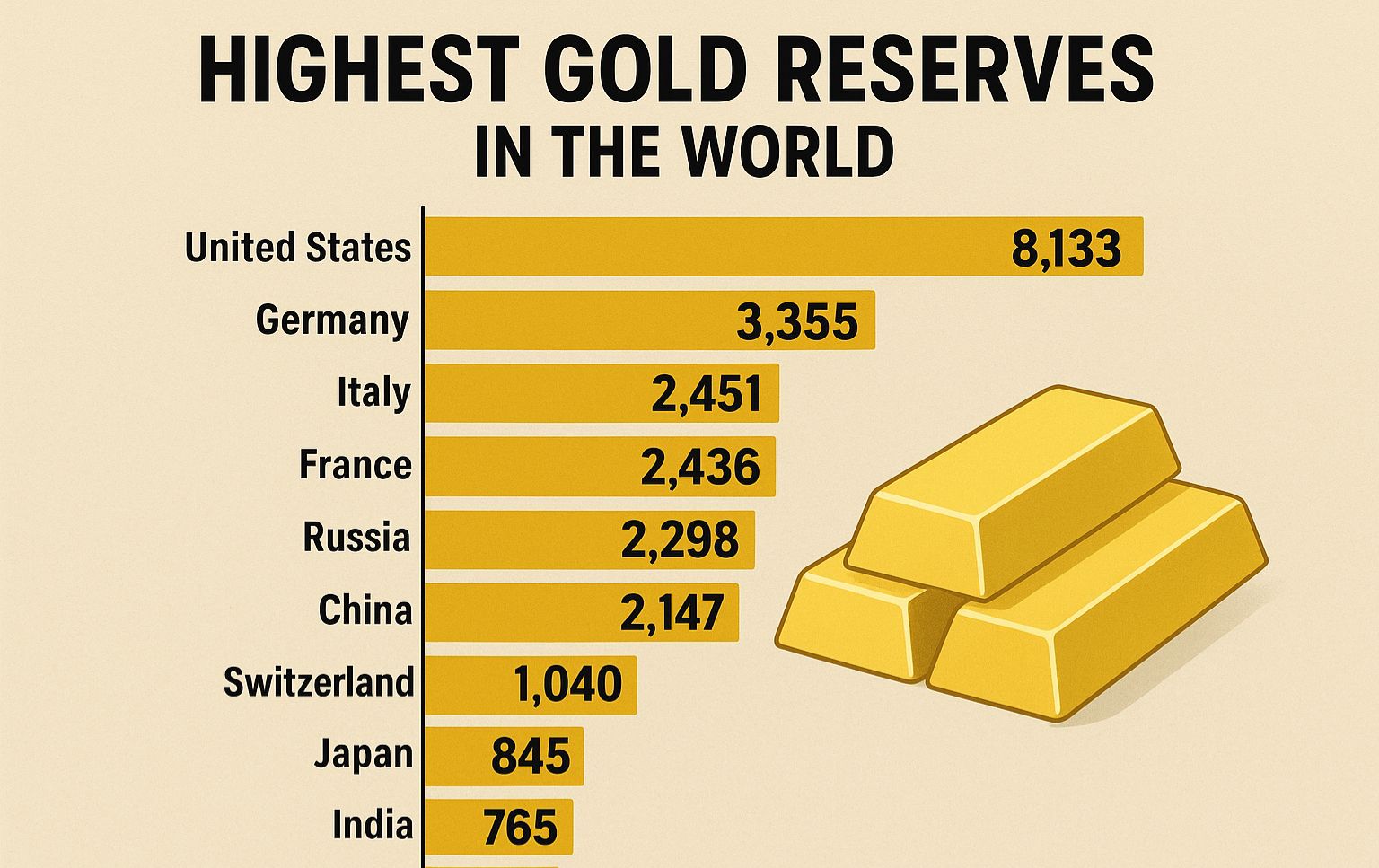
1.United States – 8,133.5 Tons
The United States holds the largest gold reserve in the world, with an impressive 8,133.5 tons of gold. This represents about 79% of the U.S. government’s foreign reserves. The majority of this gold is stored at Fort Knox in Kentucky, with additional holdings in the Federal Reserve Bank of New York. The U.S.’s massive gold reserves give it a strong position in the global economy and provide a buffer against financial volatility.
2. Germany – 3,355.0 Tons
Germany has the second-largest gold reserves in the world, totaling 3,355.0 tons. Germany’s Bundesbank (central bank) has worked diligently in recent years to repatriate much of its gold held abroad. The majority of the nation’s gold is stored in Germany, although some of it remains in the U.S., the UK, and France. Germany’s substantial gold reserves help maintain confidence in its economy and the eurozone.
3. Italy – 2,452.0 Tons
Italy holds 2,452.0 tons of gold, making it the third-largest holder of gold in the world. As one of the largest economies in Europe, Italy’s gold reserves are an essential part of its monetary policy and financial security. The Bank of Italy manages the nation’s gold reserves, which are stored in various locations, including Rome and other international vaults.
4. France – 2,437.0 Tons
France comes in at number four with 2,437.0 tons of gold in its reserves. The Banque de France is responsible for managing the nation’s gold stock, which is held in both domestic and international vaults. France’s gold reserves play an important role in maintaining the stability of the eurozone and ensuring the strength of the French economy.
5. Russia – 2,299.9 Tons
Russia’s gold reserves have been steadily increasing over the past decade, and the country now holds 2,299.9 tons of gold, making it the fifth-largest gold holder. The Central Bank of Russia has actively been buying gold to diversify its reserves and reduce dependency on the U.S. dollar. As a result, Russia’s gold reserves continue to grow, reflecting its increasing importance in the global economic sphere.
6. China – 1,948.3 Tons
China, the world’s second-largest economy, holds 1,948.3 tons of gold in its reserves. Although China is known for being the largest producer of gold, its official reserves have been increasing slowly in recent years. The People’s Bank of China manages the country’s gold reserves, which are viewed as a strategic asset to support its currency, the yuan, and bolster its economic position.
7. Switzerland – 1,040.0 Tons
Switzerland, renowned for its financial stability, holds 1,040.0 tons of gold. The country’s central bank, the Swiss National Bank (SNB), manages the nation’s gold reserves, which are stored in Switzerland and some foreign locations. Switzerland’s large gold reserves reflect its status as a global financial hub and safe haven for investments.
8. Japan – 765.2 Tons
Japan holds 765.2 tons of gold in its reserves. While Japan’s gold stock is smaller compared to other major economies, it still plays a crucial role in diversifying its foreign exchange reserves. The Bank of Japan is responsible for managing these reserves, which provide stability to the nation’s economy and contribute to its financial strength.
9. India – 754.0 Tons
India, one of the fastest-growing economies in the world, holds 754.0 tons of gold. The Reserve Bank of India (RBI) is the custodian of India’s gold reserves, which are an important part of the country’s monetary policy. India’s gold reserves are continually growing, as the country has a long history of valuing gold as a store of wealth, particularly among its large population of gold investors.
10. Turkey – 647.0 Tons
Rounding out the top 10 is Turkey, which holds 647.0 tons of gold. Over the past decade, Turkey has significantly increased its gold reserves as part of a strategy to protect its economy from external shocks. The Central Bank of the Republic of Turkey manages these reserves, which are seen as a buffer against inflation and currency volatility.
Why Do Countries Hold Large Gold Reserves?
Countries hold large gold reserves for several key reasons:
Economic Stability: Gold acts as a hedge against economic instability, currency devaluation, and inflation.
Diversification: Central banks use gold to diversify their foreign exchange reserves, reducing dependence on foreign currencies like the U.S. dollar.
Safe-Haven Asset: During times of geopolitical or financial crises, gold is seen as a safe-haven asset that maintains its value.
Currency Support: Gold can strengthen a country’s currency by increasing confidence in its financial system.
Conclusion
Gold reserves play a vital role in supporting the economic stability of nations around the world. As the global economy continues to evolve, gold will likely remain a cornerstone of financial strategies for many of the world’s leading economies. The countries listed above hold the largest gold reserves, ensuring they have the resources to weather economic challenges and maintain global influence.
By understanding the countries with the largest gold reserves, investors, economists, and policymakers can gain valuable insights into global financial trends and strategies. Whether you’re an investor looking to diversify or simply curious about the financial strategies of powerful nations, tracking gold reserves offers a window into the world of international finance.
About The Author