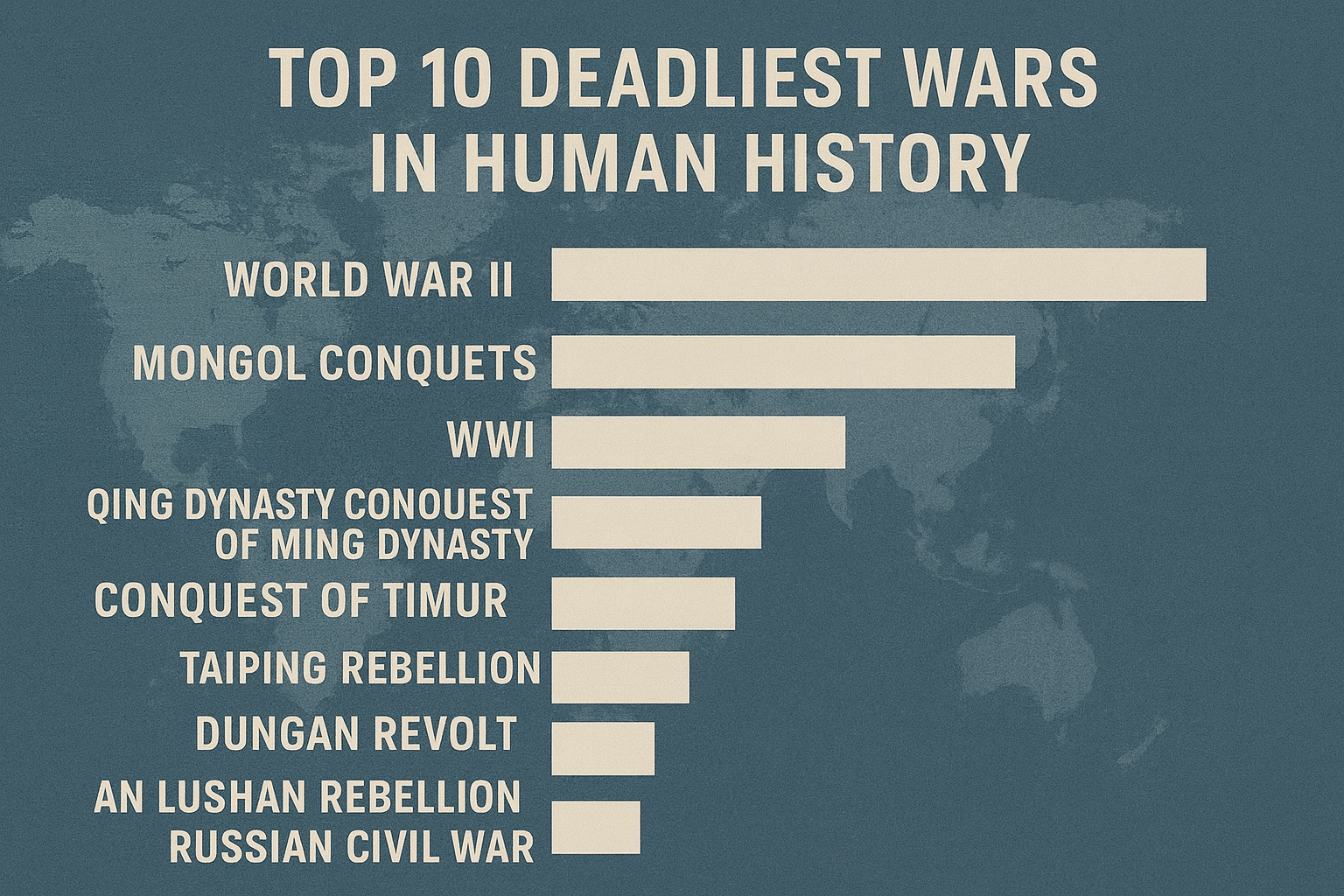
Top 10 Deadliest Wars in Human History: World War II (1939–1945), Russian Civil War (1917–1922) and Other
Throughout human history, wars have reshaped borders, destroyed civilizations, and altered the course of global politics. The deadliest wars in human history stand apart not only because of the enormous loss of life but also due to their long-term impact on societies, economies, and international relations.
This detailed list examines the ten most deadly wars ever recorded, explaining why they occurred, how they were fought, and how they changed the world.
Important Note: Casualty figures are estimates based on historical research, as exact numbers are impossible to verify, especially for older conflicts.
1. World War II (1939–1945)
Estimated Death Toll: 70–85 million
Regions Involved: Europe, Asia, Africa, Pacific
World War II remains the deadliest conflict in human history, claiming nearly 3% of the world’s population at the time. The war began due to unresolved tensions from World War I, the rise of fascist regimes, and aggressive expansion by Nazi Germany, Imperial Japan, and Fascist Italy.
The conflict introduced total war, where entire economies and civilian populations became targets. The Holocaust, mass bombings of cities like Dresden and Tokyo, and the atomic bombings of Hiroshima and Nagasaki defined the war’s unprecedented brutality.
Long-Term Impact:
- Creation of the United Nations
- Beginning of the Cold War
- End of European colonial dominance
- Nuclear weapons reshaped global security
2. Taiping Rebellion (1850–1864)
Estimated Death Toll: 20–30 million
Region: China
The Taiping Rebellion was one of the bloodiest civil wars ever fought. It began when Hong Xiuquan launched a religious movement aimed at overthrowing the Qing Dynasty. The rebellion controlled vast areas of southern China for over a decade.
Unlike conventional wars, much of the death toll came from famine, mass displacement, and disease, as agriculture collapsed and cities were destroyed.
Long-Term Impact:
- Severe weakening of the Qing Dynasty
- Increased foreign intervention in China
- Set the stage for future Chinese revolutions
3. Mongol Conquests (13th Century)
Estimated Death Toll: 30–40 million
Regions: Asia, Europe, Middle East
Led by Genghis Khan and his successors, the Mongol conquests created the largest contiguous land empire in history. Entire cities that resisted were destroyed, and populations were often executed to instill fear.
Despite the violence, the Mongols also promoted trade and cultural exchange through the Silk Road, showing how destruction and development coexisted.
Long-Term Impact:
- Collapse of several empires
- Expansion of global trade routes
- Demographic changes across Eurasia
4. World War I (1914–1918)
Estimated Death Toll: 16–20 million
Regions: Europe, Middle East, Africa
World War I began due to a complex mix of militarism, alliances, nationalism, and imperial rivalry. It is infamous for trench warfare, where soldiers faced horrific conditions for years.
Technological advances like machine guns, poison gas, and tanks led to massive casualties with minimal territorial gains.
Long-Term Impact:
- Fall of major empires
- Redrawing of national borders
- Treaty of Versailles indirectly led to World War II
5. Second Sino-Japanese War (1937–1945)
Estimated Death Toll: 15–20 million
Region: East Asia
This war began with Japan’s invasion of China and later merged into World War II. Civilians were deliberately targeted, and atrocities such as the Nanjing Massacre shocked the world.
China suffered widespread destruction of infrastructure, agriculture, and cities.
Long-Term Impact:
- Strengthened Chinese nationalism
- Weakened China economically
- Contributed to the Chinese Civil War outcome
6. Russian Civil War (1917–1923)
Estimated Death Toll: 7–12 million
Region: Russia
Following the Bolshevik Revolution, Russia descended into civil war between the Red Army and anti-Bolshevik forces. Foreign powers intervened, further intensifying the conflict.
Famine, disease, and political repression caused more deaths than direct combat.
Long-Term Impact:
- Formation of the Soviet Union
- One-party communist rule
- Global spread of communist ideology
7. Chinese Civil War (1927–1949)
Estimated Death Toll: 8–12 million
Region: China
Fought between the Chinese Communist Party and the Nationalist government, this war lasted over two decades with brief pauses. It devastated rural populations and displaced millions.
The Communist victory reshaped East Asian geopolitics.
Long-Term Impact:
- Creation of the People’s Republic of China
- Taiwan issue emerged
- Shift in global power balance
8. Thirty Years’ War (1618–1648)
Estimated Death Toll: 4.5–8 million
Region: Central Europe
Initially a religious conflict between Catholics and Protestants, the Thirty Years’ War evolved into a struggle for European dominance. Entire regions were depopulated.
Civilians suffered from looting armies, famine, and disease.
Long-Term Impact:
- Treaty of Westphalia
- Birth of modern nation-state system
- Decline of religious wars in Europe
9. Napoleonic Wars (1803–1815)
Estimated Death Toll: 3.5–6 million
Regions: Europe, Middle East
Fought under the leadership of Napoleon Bonaparte, these wars reshaped Europe through massive conscription and national armies.
Diseases like typhus killed more soldiers than battlefield combat.
Long-Term Impact:
- Spread of nationalism
- Redrawing of European borders
- End of feudal military systems
10. Korean War (1950–1953)
Estimated Death Toll: 2.5–3 million
Region: Korean Peninsula
The Korean War was a major Cold War conflict involving North Korea, South Korea, the United States, China, and the United Nations.
Despite ending in a stalemate, it left Korea divided and heavily militarized.
Long-Term Impact:
- Permanent division of Korea
- Militarization of East Asia
- Escalation of Cold War tensions
Why These Wars Were Exceptionally Deadly
Common factors behind extreme casualties include:
- Targeting of civilian populations
- Lack of medical care
- Famine and disease
- Ideological extremism
- Long duration and total warfare
Final Conclusion
The deadliest wars in human history are stark reminders of the human cost of conflict. These wars not only killed millions but reshaped borders, ideologies, and global power structures.
Studying them helps humanity understand the consequences of war — and the importance of preventing future conflicts.
Disclaimer
The information in this article is based on publicly available sources and general knowledge. Details, figures, or timelines may vary across sources. This content is for informational purposes only and is not intended to mislead.
About The Author