The Bhagavad Gita Chapter 5 Source- AI
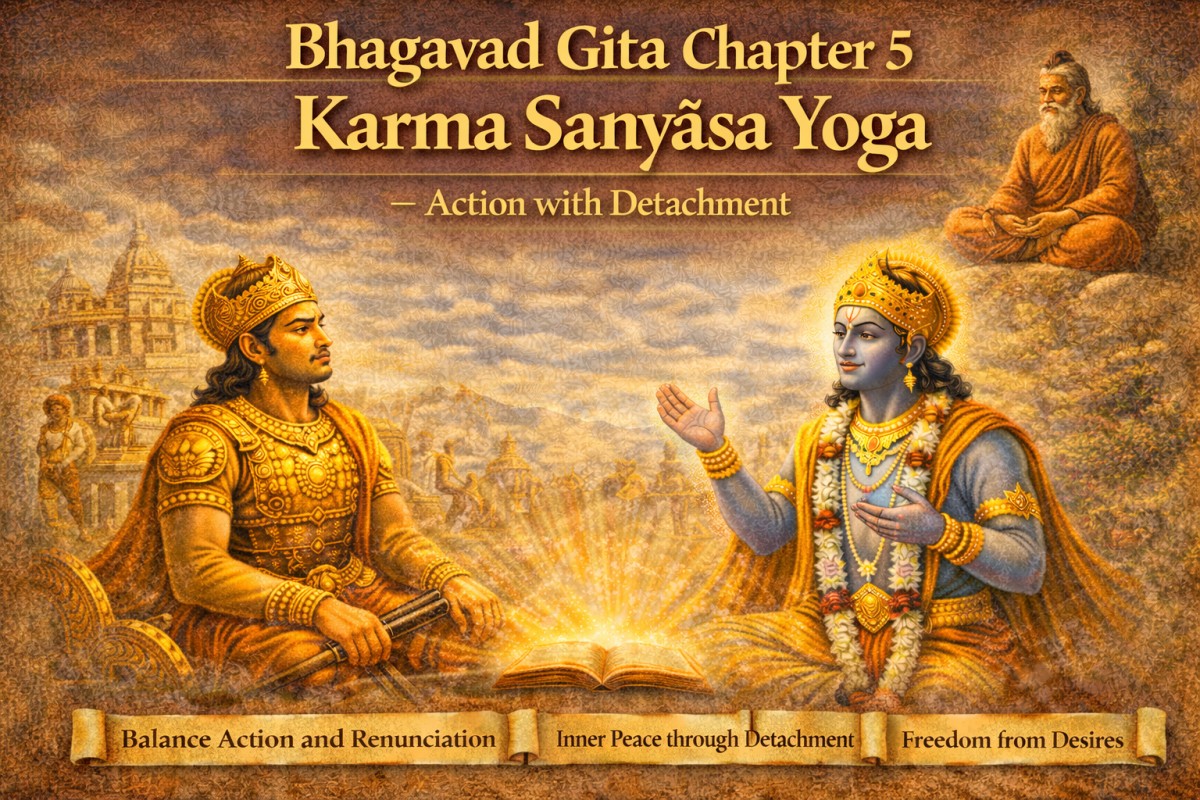
The fifth chapter of the Bhagavad Gita, called Karma Sanyāsa Yoga, talks about a very common confusion in spiritual life: Should we leave all actions and live as a renunciant, or should we stay in the world and keep doing our duties?
Arjuna has the same doubt, and Lord Krishna clears it by teaching that real spirituality is not about running away from life, but about doing our work with a detached and pure mind.
Renunciation Doesn’t Mean Running Away
Krishna teaches that real renunciation (sanyāsa) is not about quitting work or responsibilities. It’s about giving up attachment, the inner desire for rewards, praise, or success. A person who neither hates work nor runs after results is truly free.
Even those who live and work in the world can attain the same spiritual state as those who choose a life of quiet meditation, if they perform every action without selfish motives.
The Power of Inner Balance
Krishna says that a wise person doesn’t see knowledge (Jnana Yoga) and action (Karma Yoga) as separate. Both lead to the same goal, freedom and peace (moksha).
But walking the path of action with detachment is easier for most of us, because it helps purify the mind naturally through daily duties.
Those who control their mind and senses, and keep their heart pure, remain peaceful even while working. Their actions don’t “stick” to them, just as a lotus flower stays untouched by the water it grows in.
Acting Without Ego
Krishna describes a true yogi as someone who sees life with understanding. Such a person thinks, “I am not the doer.”
The body and senses act according to nature, seeing, hearing, eating, and moving, but the soul remains pure and still.
When all actions are mentally offered to God, the person becomes free from sin and worry. Work becomes a sacred act instead of a burden.
Work as a Path to Purity
People who practice Karma Yoga work with body, mind, and heart to serve others and grow spiritually. They do their duty but stay detached from results. Those who give up the fruits of their actions attain deep peace. But those who keep chasing results become restless and trapped in endless desire. Such a peaceful person lives happily within this “nine-gated city”, the human body, knowing that the Self (Atma) is the real doer, not the body or ego.
Understanding God’s Role
Krishna explains that the soul (Atma) does not create actions, rewards, or sins. All actions happen because of nature. But due to a lack of understanding, we start thinking, “I am doing everything,” and this makes us stuck in the cycle of karma.
When this lack of understanding goes away through true knowledge, wisdom lights up our life like sunlight. Then we realize our real nature and feel connected to the Supreme Truth (Brahman).
Seeing All Beings as Equal
A realized person looks at every being, a wise Brahmana, a cow, a dog, or even an outcast, with the same vision.
They understand the divine presence in all. For such souls, pleasure and pain, gain and loss, are just experiences that come and go; they neither break nor excite them.
Real Happiness Lies Within
Krishna reminds Arjuna that real happiness doesn’t come from external things. Pleasures that depend on the senses bring temporary joy but end in pain. True joy comes from inner peace, being one with your higher Self.
A person who controls desires and anger enjoys harmony within. One who finds happiness inside the heart, who lives with self-control and goodwill toward others, attains moksha, true freedom.
The Path to Freedom
Krishna explains that true freedom comes when a person rises above anger, desire, and ego. Wise people keep their minds calm, control their senses, and are not afraid or attached to anything. Because of this, they experience deep peace and remain connected to God in every moment of life.
Ultimately, Krishna states that when we perceive God as the supreme power, the true enjoyer of all things, and the loving friend of all living beings, our hearts become at peace. Such a person feels calm and safe in all situations.
Conclusion
Karma Sanyāsa Yoga shows that the real change is inside, not outside. A person may live in a busy city, do a normal job, care for family, and still be a true yogi if the heart is free from selfish desire and ego.
When we see God as the enjoyer of all our efforts, the Lord of all worlds, and the well‑wisher of every being, the mind naturally becomes peaceful, and life itself turns into a spiritual path.
Disclaimer:
This content is for general informational purposes about spiritual teachings in India and worldwide. It is not professional or personal advice. For guidance, consult authentic sources or qualified spiritual teachers.
About The Author