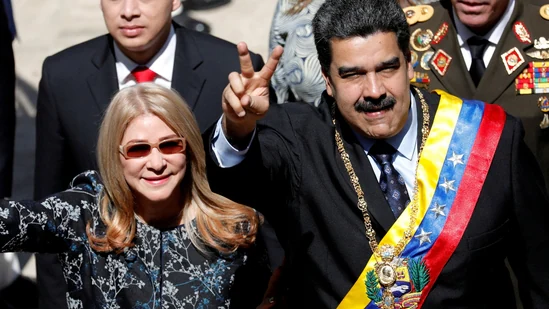
Cilia Flores, the wife of Venezuelan President Nicolás Maduro and one of the most powerful figures in the country’s ruling establishment, is now in U.S. custody, according to confirmations from the White House and the U.S. Department of Justice late Saturday.
The development follows a rapid escalation earlier in the day, when unverified reports of her detention began circulating. Those claims have since been confirmed by multiple major international news organizations, including The Associated Press, CBS News, and The Guardian.
Flores and Maduro were detained during a U.S.-led military operation in Caracas and are currently being transported to the United States to face federal charges.
Detention Confirmed After Operation Southern Spear
According to U.S. officials, Flores was detained alongside Maduro during Operation Southern Spear, a pre-dawn raid carried out by U.S. Army Delta Force at their residence within the Fuerte Tiuna military complex, one of Venezuela’s most secure installations.
U.S. authorities said the pair were extracted by helicopter and transferred to the USS Iwo Jima, a U.S. Navy amphibious assault ship operating in the Caribbean. President Donald Trump confirmed the operation and transfer in public remarks Saturday evening.
The two are expected to be transported to New York City, where federal court proceedings could begin as early as Monday.
Federal Charges Filed in New York
U.S. Attorney General Pam Bondi announced that Flores and Maduro have been indicted in the Southern District of New York, marking the first time Flores herself has faced direct criminal prosecution in the United States.
According to the Justice Department, the charges include:
- Narco-terrorism conspiracy
- Cocaine importation conspiracy
Prosecutors allege that Flores and Maduro played senior roles in what U.S. authorities describe as the “Cartel of the Suns,” an organization accused of using Venezuelan state institutions to facilitate large-scale drug trafficking into the United States.
Bondi said the case represents a significant step in U.S. efforts to hold senior Venezuelan officials accountable.
Who Is Cilia Flores?
Cilia Adela Flores de Maduro has been a central figure in Venezuelan politics for more than two decades. Trained as a lawyer, she rose to prominence during the presidency of Hugo Chávez and later became one of Nicolás Maduro’s closest political allies.
She served as President of the National Assembly from 2006 to 2011, becoming the first woman to hold the position. Flores later played a key advisory role after Maduro succeeded Chávez in 2013, frequently appearing alongside him at domestic and international events.
Often referred to by supporters as “La Primera Combatiente” (“The First Fighter”), Flores was widely regarded as one of the most influential figures within the ruling Socialist Party.
Prior International Scrutiny
Flores has long been under international scrutiny. In 2016, two of her nephews were convicted in the United States on drug trafficking charges, a case that intensified attention on the Maduro family, though Flores herself was not charged at the time.
She has also been subject to U.S. sanctions, along with other senior Venezuelan officials, as part of broader measures targeting the Maduro government.
Reaction in Venezuela and Abroad
In Caracas, Vice President Delcy Rodríguez condemned the operation, calling it an “illegal abduction” and demanding proof that the detained leaders are alive. The Venezuelan government announced emergency measures as tensions rose across the capital.
In the United States, President Trump said the operation was necessary to restore regional stability, though no formal announcement has been made regarding any interim governance arrangement for Venezuela.
Regional air and sea traffic around parts of the Caribbean, including routes near Aruba, Curaçao, and Puerto Rico, has faced disruptions amid heightened U.S. military activity.
What Happens Next
U.S. officials say Flores and Maduro remain in transit and under military custody. Formal court appearances are expected once they arrive in New York, where the cases will be handled by federal prosecutors.
The detentions represent one of the most dramatic developments in U.S.–Venezuela relations in decades and are expected to have wide-ranging political and diplomatic consequences across Latin America.
About The Author