7 Shocking Epstein Files Revelations You Probably Didn’t Know
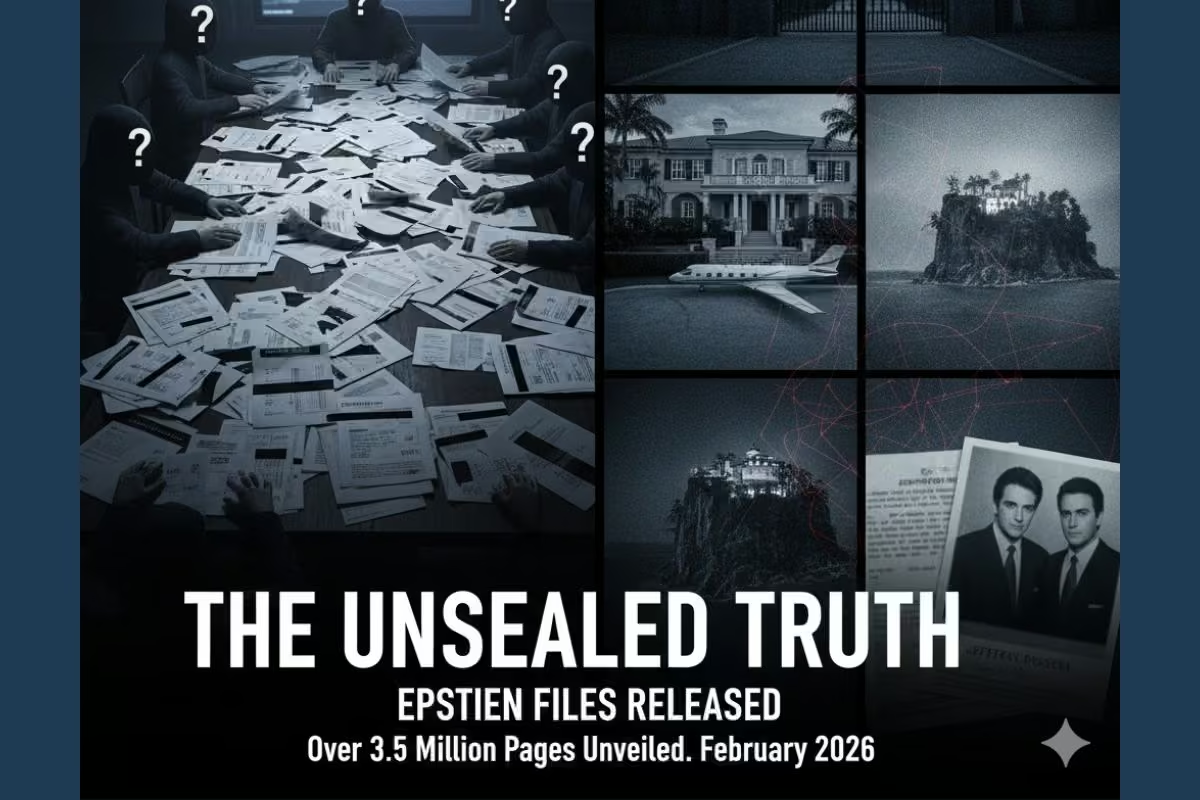
As of February 2026, the global legal landscape has been permanently altered by the Epstein Files Transparency Act, which led to the unsealing of over 3.5 million pages of investigative records. While media headlines often focus on the same few famous names, a deeper dive into the technical filings and depositions reveals a far more complex—and disturbing—infrastructure.
Here are 7 unknown facts and hidden revelations from the Epstein files that provide a new perspective on the decade-long investigation.
1. The “Standardized Gateway” Recruitment Manual
Unsealed depositions from former staff members revealed that Epstein’s recruitment of victims was not random but followed a rigid, professionalized script. He referred to it as a “pyramid scheme” for human trafficking.
- The Incentive: Older victims were often paid $200 to $500 in cash for every new girl they successfully recruited.
- The “Standard Massage” Script: New girls were told they were being hired to give a “therapeutic massage” to a billionaire, with specific instructions on how to transition the session into sexual acts. This was documented in internal “training notes” found at his New York residence.
2. Hidden Surveillance and the “Blackmail Room”
While rumors of cameras have existed for years, the 2026 file release confirmed that Epstein’s Palm Beach and New York residences were essentially wired like a high-end intelligence facility.
- The Evidence: FBI evidence logs include descriptions of pinhole cameras hidden in light fixtures, smoke detectors, and even picture frames in guest suites.
- The Intent: Witnesses testified that the footage was not just for personal use but was intended as “insurance” or kompromat against high-profile guests, explaining why many associates may have felt pressured to maintain ties with him even after his 2008 conviction.
3. The Failed “Indictment of 2007”
One of the most legally explosive documents is a draft federal indictment from 2007 that was never filed.
- What was in it: Unlike the state-level solicitation charge Epstein eventually took, this 53-page federal draft contained counts of conspiracy, racketeering, and international sex trafficking of minors.
- The Switch: The files detail the high-level pressure exerted by Epstein’s legal team on Alexander Acosta (the then-U.S. Attorney) to scrap the federal case in favor of the now-infamous “sweetheart deal” that granted him—and his unnamed co-conspirators—broad immunity.
4. Direct Financial Links to Elite Academics
The files shed a harsh light on how Epstein used “science philanthropy” to buy social legitimacy.
- The Harvard Visit: Documents show Epstein was admitted as a Visiting Fellow at Harvard in 2005 despite lacking any academic credentials.
- The Pay-to-Play: Emails reveal that Epstein gave over $9 million to various Harvard faculty programs. When researchers complained about his presence, university officials reportedly ignored the warnings to protect the flow of donations.
5. The 2010 “Buckingham Palace” Dinner Invitation
A significant batch of emails released in early 2026 contradicted Prince Andrew’s 2019 claim that he had “distanced” himself from Epstein after the 2008 conviction.
- The Email: In September 2010, the Duke of York (referred to as “The Duke”) sent a cordial invitation to Epstein for “dinner at Buckingham Palace” to celebrate Epstein’s release from house arrest.
- The Follow-up: The files include photos taken during this period showing the pair walking together in Central Park, proving their friendship remained intact years after the public was told it had ended.
6. Mismanagement of Prison Surveillance Footage
New reports from the DOJ Inspector General (unsealed in late 2025) provided the technical reason for the missing footage of Epstein’s death in his jail cell.
- The Truth: It wasn’t just one camera; out of 11 cameras in the Special Housing Unit (SHU), 10 were non-functional due to “malfunctioning hard drives” that had been ignored for months.
- The Recovery Effort: Forensics experts recently attempted to recover data from these drives, only to find they had been overwritten by newer footage, effectively erasing the record of who may have entered the tier on the night of August 10, 2019.
7. The “John Doe” Flaw in Redactions
A major scandal erupted in late 2025 when it was discovered that the Justice Department had used faulty redaction software on the initial file release.
- The Leak: Because the files were published as PDFs with black bars that were not properly “flattened,” tech-savvy users found they could copy and paste the blacked-out text into Word documents to reveal the hidden names.
- The Fallout: This mistake inadvertently exposed the identities of at least 43 victims and several high-profile associates whose names were supposed to remain sealed under court order.
Disclaimer: The information provided in this article is for educational and informational purposes only. The details regarding the “Epstein Files” are based on public court records, unsealed depositions, and official government reports available as of February 2026. Mention of any individual’s name in these documents does not necessarily imply criminal conduct or wrongdoing; in many cases, names appear as part of travel logs, social connections, or witness testimonies. Readers are encouraged to verify facts through official judicial sources.
About The Author