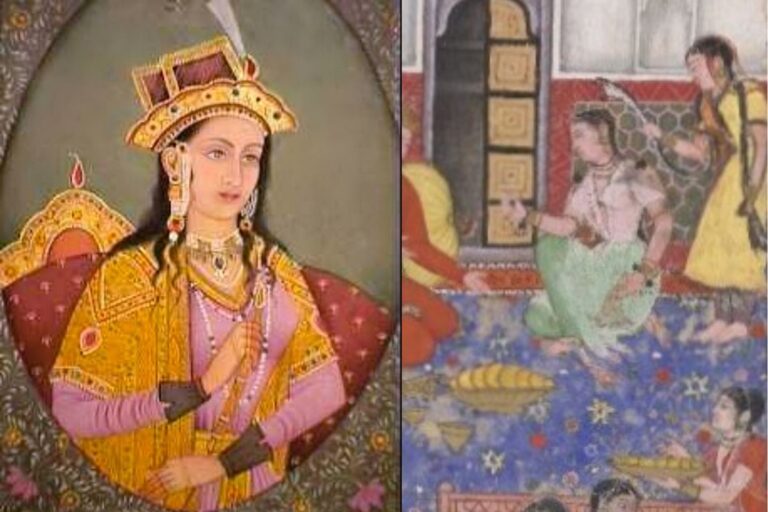
When we talk about feminism in India, names from the modern era often dominate the conversation. However, centuries before the word feminism existed, one Mughal queen quietly but powerfully challenged patriarchal norms and reshaped women’s role in governance. Nur Jahan, the only Mughal empress to wield real political power, stands today as one of the earliest feminist icons in Indian history.
Who Was Nur Jahan?
Born as Mehr-un-Nissa in 1577, Nur Jahan was the wife of Mughal Emperor Jahangir. Unlike most royal women of her time, she was not confined to the zenana (women’s quarters). Instead, she emerged as the de facto ruler of the Mughal Empire, exercising authority that no Mughal woman before or after her achieved.
In 1611, after marrying Jahangir, she was given the title “Nur Jahan Begum”, meaning Light of the World. The title proved prophetic.
A Woman Who Ruled an Mughal Empire
Nur Jahan’s rise to power was unprecedented in Mughal India. As Jahangir’s health deteriorated due to alcoholism and illness, the empire increasingly came under her control.
Key Achievements That Made Nur Jahan a Feminist Icon
- Royal Decrees Issued in Her Name
Coins were minted bearing Nur Jahan’s name — a remarkable honor in a deeply patriarchal era. - Political Decision-Maker
She attended court, influenced state policies, appointed officials, and even decided matters of war and diplomacy. - First Woman to Lead the Mughal Empire in Practice
While Jahangir remained emperor in name, Nur Jahan was the power behind the throne.
Champion of Women’s Rights in the 17th Century
Nur Jahan’s feminism was not theoretical; it was practical and visible.
Empowering Women Beyond the Palace
- She supported widow remarriage, a taboo practice at the time.
- She ensured financial support and protection for women, especially widows and orphaned girls.
- She encouraged women’s education and economic participation.
In an era when royal women were expected to remain invisible, Nur Jahan redefined what leadership looked like.
Patron of Art, Architecture, and Fashion
Nur Jahan was also a cultural icon.
- She introduced Persian-inspired fashion, including refined versions of what later evolved into salwar-kameez styles.
- She designed perfumes and textiles, turning royal aesthetics into tools of soft power.
- She commissioned architectural masterpieces, including the Tomb of Itimad-ud-Daulah in Agra, often called the Baby Taj.
These contributions gave women visibility not just in politics but also in culture and commerce.
Why Nur Jahan Was Truly Ahead of Her Time
Unlike symbolic queens, Nur Jahan exercised real authority in:
- Governance
- Military strategy
- Economic administration
She proved that leadership is not gendered — a belief that aligns strongly with modern feminist thought.
Nur Jahan vs Other Mughal Women
While women like Jodha Bai, Mumtaz Mahal, and Gulbadan Begum played influential roles, Nur Jahan stands apart because:
- She held independent power
- She ruled without a male regent
- Her authority was officially recognized
No other Mughal queen reached her level of political autonomy.
Legacy: India’s Forgotten Feminist Icon
Despite her immense contributions, Nur Jahan’s legacy is often overshadowed in mainstream history books. Today, historians and feminists alike are revisiting her story as an example of early Indian feminism rooted in action, not slogans.
Her life challenges the misconception that women’s empowerment is a modern concept in India.
Why Nur Jahan Matters Today
In an age of conversations around gender equality, leadership, and representation, Nur Jahan’s story offers a powerful reminder:
Indian women have always been capable leaders — history just hasn’t always told their stories.
Conclusion
Nur Jahan was not just a Mughal queen; she was a trailblazer, strategist, administrator, and feminist icon centuries before the term existed. Her life is a testament to courage, intellect, and the timeless fight for women’s agency in public life.
Rediscovering her story is not just about the past — it is about redefining the narrative of women’s power in India.
About The Author