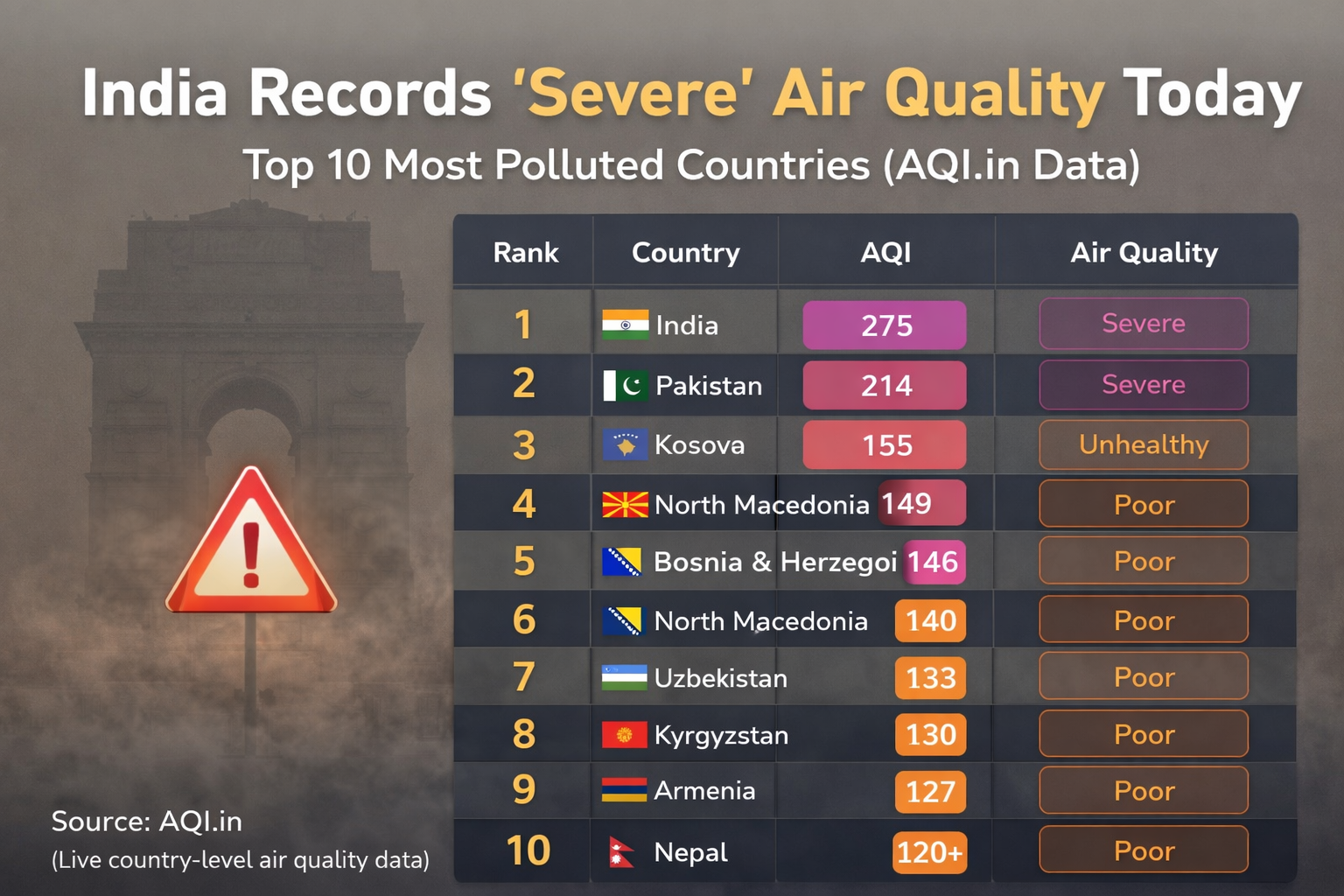
India has emerged as the most polluted country in the world today, according to the latest live country-level Air Quality Index (AQI) data from AQI.in. As of December 20, 2025 (around 9:34 PM IST), India recorded an average AQI of 275, placing it in the “Severe” air quality category.
The deteriorating air quality has once again brought the spotlight on Delhi-NCR, where dense smog continues to blanket the region, causing breathing discomfort, reduced visibility, and growing health concerns.
Top 10 Most Polluted Countries in the World Today
Note: countries rankings fluctuate hourly due to weather and local emissions.
| Rank | Country | AQI | Air Quality Category |
|---|---|---|---|
| 1 | India | 275 | Severe |
| 2 | Pakistan | 214 | Severe |
| 3 | Kosovo | 155 | Unhealthy |
| 4 | North Macedonia | 149 | Poor |
| 5 | Bosnia & Herzegovina | 146 | Poor |
| 6 | North Macedonia (Region) | 140 | Poor |
| 7 | Uzbekistan | 133 | Poor |
| 8 | Kyrgyzstan | 130 | Poor |
| 9 | Armenia | 127 | Poor |
| 10 | Nepal | 120+ | Poor |
What Does India’s ‘Severe’ AQI Indicate?
An AQI reading of 275 falls under the “Severe” category, which means:
- Serious health risks for children, elderly people, pregnant women, and those with asthma or heart disease
- Prolonged exposure may affect even healthy individuals
- Outdoor activities should be strictly limited
Experts warn that continuous exposure to such air is equivalent to smoking multiple cigarettes daily, depending on local pollution intensity.
Delhi-NCR: A Major Contributor to India’s Poor AQI
While the data reflects country-level averages, Delhi-NCR remains one of the biggest contributors to India’s severe air quality status. Several monitoring stations across:
- Delhi
- Ghaziabad
- Noida
- Faridabad
continue to record “Very Poor” to “Severe” AQI levels, driven largely by PM2.5 particulate matter.
Why Is Air Pollution So High Right Now?
Environmental experts cite multiple factors behind the worsening air quality:
- Winter temperature inversion, trapping pollutants near the ground
- Low wind speed and high humidity, preventing dispersion
- Vehicular emissions and local pollution sources
- Geographical disadvantage of the Indo-Gangetic Plain
These conditions collectively worsen air quality during December and January every year.
What Does ‘Severe’ AQI Mean for Health?
An AQI above 300 can:
- Cause breathing difficulty even in healthy individuals
- Trigger asthma, bronchitis, and heart problems
- Increase hospital visits and respiratory distress
Health experts advise avoiding outdoor activity, wearing N95/N99 masks, and using air purifiers indoors.
What to Expect Next?
Meteorologists say air quality may remain poor to severe over the next 2–3 days, unless strong winds or rainfall bring relief. Authorities may continue restrictions depending on local AQI trends.
Disclaimer
This article is based on live country-level AQI data from AQI.in as observed on December 20, 2025. Air quality values vary by location and time. Readers are advised to track local AQI updates and follow official health advisories.
Frequently Asked Questions
1. What Do the AQI Colors Mean?
- 🟢 Green – Good air
- 🟡 Yellow – Moderate
- 🟠 Orange – Poor
- 🔴 Red – Very Poor
- 🟣 Purple – Severe
In your screenshot, India is shown in purple, meaning the air quality is Severe.
2. Country AQI vs City AQI (Important Difference)
- Country AQI = Average air quality across many cities
- City AQI = Pollution level in one specific city
- Local Station AQI = Air quality at one exact location
👉 This means:
- India’s average AQI is 275 (Severe)
- But some cities (like Delhi-NCR) can be much worse, while others may be slightly better
3. What Is PM2.5 and Why Is It Dangerous?
- PM2.5 are extremely tiny pollution particles
- They can enter lungs and bloodstream
- Main causes: vehicle smoke, burning, dust, factories
High PM2.5 is the main reason AQI rises in winter.
4. How Often Does AQI Change?
- AQI updates every 15–60 minutes
- Weather, wind, traffic, and burning can change AQI quickly
- That’s why rankings keep shifting throughout the day
5. What Should You Do When AQI Is ‘Severe’?
- Stay indoors as much as possible
- Avoid outdoor exercise
- Wear N95/N99 masks if going out
- Use air purifiers indoors
- Children, elderly, and asthma patients should take extra care
About The Author