India has reached a major milestone in the global technology race. According to the Stanford Global AI Competitiveness Index 2025, India has secured the 3rd position worldwide, placing it among the top artificial intelligence (AI) leaders globally. The United States and China continue to dominate the list, but India’s rapid rise highlights its growing influence in the global AI ecosystem.
This achievement reflects India’s strong progress in AI talent, innovation, startups, and government-led digital initiatives.
What Is the Stanford Global AI Competitiveness Index?
The Stanford Global AI Competitiveness Index, published by Stanford University, measures how well countries are prepared for the AI-driven future. Instead of focusing on just one factor, the index evaluates multiple areas, such as:
- AI research and development
- Availability of skilled AI talent
- Government policies and investments
- Startup and innovation ecosystem
- Infrastructure and computing power
- Responsible and ethical use of AI
The goal is to understand how competitive and “AI-ready” a country truly is.
Top 10 Countries in AI Competitiveness (2025)
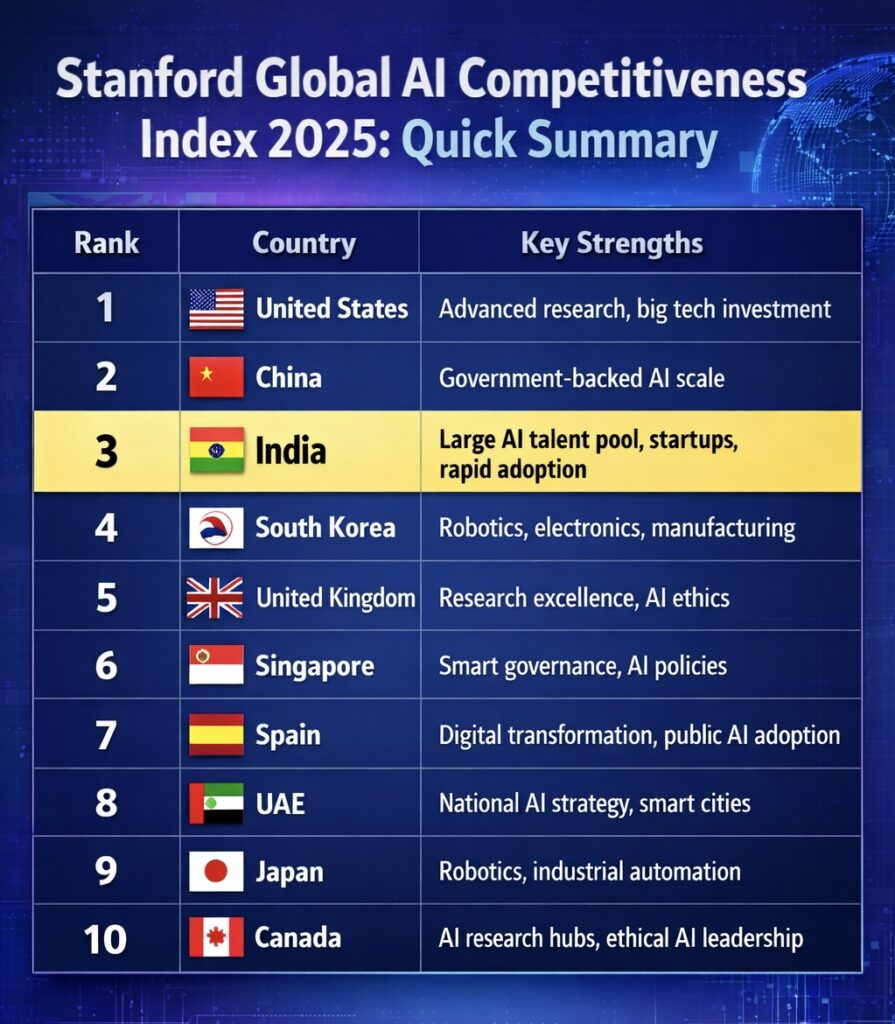
Here’s how the world’s leading nations rank in the Stanford AI Index 2025:
🇺🇸 United States – Rank 1
The United States continues to lead the global AI race by a wide margin. It dominates in advanced AI research, foundation models, and private investment. Home to top universities, tech giants, and AI labs, the US benefits from strong collaboration between academia, startups, and industry. Massive funding and early adoption keep it firmly at the top.
🇨🇳 China – Rank 2
China holds the second position due to its large-scale AI deployment and strong government backing. The country has made rapid progress in AI-driven surveillance, smart cities, manufacturing, and computer vision. China’s centralized policy approach and focus on industrial AI give it a competitive edge globally.
🇮🇳India – Rank 3
India’s rise to third place is one of the biggest highlights of the 2025 index. The country stands out for its huge AI talent pool, growing startup ecosystem, and increasing AI adoption across sectors like fintech, healthcare, education, and governance. Government initiatives such as the IndiaAI Mission and Digital India have accelerated infrastructure and skill development, helping India compete with advanced economies.
🇰🇷 South Korea – Rank 4
South Korea remains a strong AI player, especially in electronics, robotics, and smart manufacturing. Heavy investments in AI-driven innovation and close coordination between the government and private sector support its position in the top five.
🇬🇧 United Kingdom – Rank 5
The UK ranks high due to its strong academic research, AI ethics leadership, and growing startup culture. London continues to be a major AI innovation hub in Europe, attracting global investment and talent.
🇸🇬 Singapore – Rank 6
Despite its small size, Singapore performs exceptionally well in AI governance, smart infrastructure, and business adoption. Clear regulations and strong public-private partnerships make it one of Asia’s most AI-ready nations.
🇪🇸 Spain – Rank 7
Spain has shown steady growth in AI research and digital transformation. Its focus on AI integration in public services and industry has helped it enter the global top 10.
🇦🇪 United Arab Emirates – Rank 8
The UAE is emerging as a regional AI hub in the Middle East. Heavy government investment, national AI strategies, and smart city initiatives have rapidly boosted its global standing.
🇯🇵 Japan – Rank 9
Japan remains strong in robotics, automation, and industrial AI. While its pace is slower compared to newer AI leaders, deep integration of AI in manufacturing keeps it competitive.
🇨🇦 Canada – Rank 10
Canada rounds out the top 10 with strengths in AI research, talent development, and ethical AI frameworks. Cities like Toronto and Montreal continue to attract global AI researchers.
India’s entry into the top three is especially significant, as it stands alongside the world’s biggest technology superpowers.
List of 10 Countries in Stanford Global AI Competitiveness Index 2025
Why India Ranked 3rd Globally in AI
1. Rapid Growth of AI Talent in India
India has one of the largest pools of engineers and software developers in the world. In recent years, AI skills such as machine learning, data science, and generative AI have seen massive adoption across Indian companies, universities, and startups.
2. Strong Government Push for AI
Initiatives like the IndiaAI Mission and Digital India have played a key role. The government is investing heavily in AI research, high-performance computing, and data infrastructure to support innovation across sectors such as healthcare, education, agriculture, and governance.
3. Thriving Indian Startup Ecosystem
From Bengaluru and Hyderabad to Delhi-NCR and Mumbai, Indian startups are using AI to solve real-world problems. AI-powered fintech, health tech, ed-tech, and e-commerce platforms have strengthened India’s position in the global AI economy.
4. High AI Adoption Across Industries
Indian companies are actively using AI for customer service, automation, cybersecurity, logistics, and financial services. This real-world adoption boosts India’s overall AI competitiveness score.
What This Ranking Means for India
- 🌍 Global recognition as a serious AI contender
- 💼 More foreign investment in Indian AI startups
- 🎓 Increased focus on AI education and skill development
- 🤝 Stronger global partnerships in technology and innovation
This ranking also strengthens India’s position in shaping global conversations around ethical AI, data privacy, and inclusive technology.
Conclusion
India’s 3rd-place ranking in the Stanford Global AI Competitiveness Index 2025 marks a turning point in the country’s digital journey. While the US and China remain ahead, India’s momentum, talent base, and policy support show that it is quickly closing the gap.
As AI continues to reshape the world, India is no longer just a technology services hub — it is emerging as a global AI powerhouse.
Disclaimer
This article is based on publicly available information from the Stanford Global AI Competitiveness Index 2025 and related reports. Rankings, scores, and interpretations are subject to change as new data, methodologies, or official updates are released. This content is intended for informational and educational purposes only and should not be considered as professional, financial, or policy advice.
About The Author