The Mughal Empire ruled India for over three centuries, from the early 16th century to the 18th century. Known for its powerful emperors, grand architecture, art, and culture, the Mughals left a legacy that continues to fascinate historians, tourists, and students of history.
Understanding the Mughal family tree helps us see how the empire grew, the rulers’ achievements, and the amazing monuments they built.
Here is the list of key emperor of mughal history:
1. Babur (r. 1526–1530) – The Founder of the Mughal Empire
Who He Was: Babur was born in 1483 in Fergana, present-day Uzbekistan. He was a descendant of Timur on his father’s side and Genghis Khan on his mother’s side. Babur was a skilled warrior and a poet who dreamed of conquering India.
What Babur Built/Did:
- Founded the Mughal Empire after defeating Ibrahim Lodi in the First Battle of Panipat in 1526.
- Introduced artillery and modern warfare techniques to India.
- Wrote the famous memoir, Baburnama, describing his life, battles, and thoughts.
- Started garden culture in India with Persian-style gardens.
Interesting Fact: Babur was only 13 years old when he became the ruler of his small kingdom in Fergana!
Legacy: Babur laid the foundation of one of the most powerful empires in Indian history.
2. Humayun (r. 1530–1540, 1555–1556) – The Exiled Emperor
Who He Was: Humayun, Babur’s son, was gentle and artistic. Unlike his father, he faced many struggles early in his reign.
What Hunayun Built/Did:
- Lost his kingdom to Sher Shah Suri, a rival ruler, and lived in exile in Persia.
- Regained his throne in 1555 with Persian help.
- Built Humayun’s Tomb in Delhi, a masterpiece of Mughal architecture that inspired the Taj Mahal.
Interesting Fact: Humayun’s Tomb was the first garden tomb in India, combining Persian and Indian styles.
Legacy: Humayun’s reign taught the empire the importance of patience, diplomacy, and learning from other cultures.
3. Akbar the Great (r. 1556–1605) – The Visionary Ruler
Who He Was: Akbar, Humayun’s son, is remembered as one of India’s greatest emperors. He became king at only 13 years old.
What Akbar Built/Did:
- Expanded the empire to cover most of northern and central India.
- Promoted religious tolerance with his policy Sulh-i-Kul (peace for all).
- Built Fatehpur Sikri, a city with grand palaces, mosques, and administrative buildings.
- Encouraged art, literature, and music, making the Mughal court a cultural hub.
Interesting Fact: Akbar had a library of over 24,000 books and invited scholars of all religions to his court.
Legacy: Akbar united India under strong administration and tolerance, setting the stage for a golden era of the Mughals.
4. Jahangir (r. 1605–1627) – The Lover of Art and Nature
Who He Was: Jahangir, Akbar’s son, was a lover of art, gardens, and justice. He was known for being fair in administration.
What Jahangir Built/Did:
- Strengthened Mughal administration and law systems.
- Promoted miniature paintings, which became highly detailed and famous worldwide.
- Built Shalimar Bagh in Kashmir and contributed to other architectural works.
Interesting Fact: Jahangir loved nature and had a collection of rare birds, animals, and plants in his palace gardens.
Legacy: Jahangir’s reign is remembered for cultural refinement and artistic achievements.
5. Shah Jahan (r. 1628–1658) – The Architect of Monuments
Who He Was: Son of Jahangir, Shah Jahan is called the “Builder Emperor” because of the magnificent structures he created.
Whata Shah Jahan Built/Did:
- Constructed the Taj Mahal in Agra in memory of his wife Mumtaz Mahal.
- Built Red Fort and Jama Masjid in Delhi.
- Promoted Mughal architecture that combined Persian, Indian, and Islamic styles.
Interesting Fact: The Taj Mahal changes color depending on the time of day, from pink in the morning to golden under moonlight.
Legacy: Shah Jahan made the Mughal Empire famous for its art, architecture, and beauty.
6. Aurangzeb (r. 1658–1707) – The Last Strong Emperor
Who He Was: Aurangzeb, Shah Jahan’s son, was a strict ruler known for his expansionist policies and devotion to Islamic principles.
What Aurangzeb Built/Did:
- Expanded the Mughal Empire to its largest territorial extent.
- Built Bibi Ka Maqbara in Aurangabad.
- Focused on law, governance, and military campaigns across India.
Interesting Fact: Despite being strict, Aurangzeb was a capable administrator and ensured the empire ran efficiently.
Legacy: Aurangzeb’s reign marked the height of the empire, but strict policies and prolonged wars eventually weakened Mughal power.
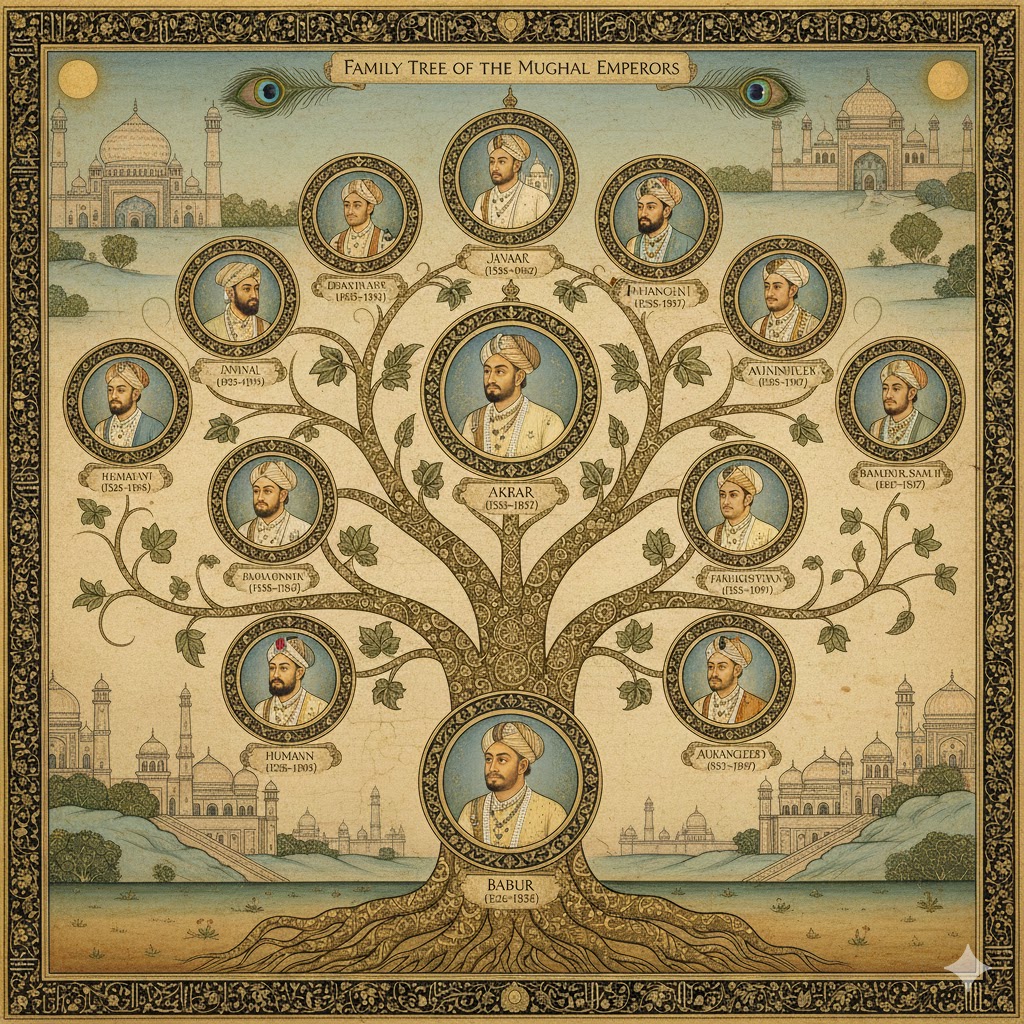
Mughal Family Tree Overview
Here’s a simplified view of the Mughal lineage:
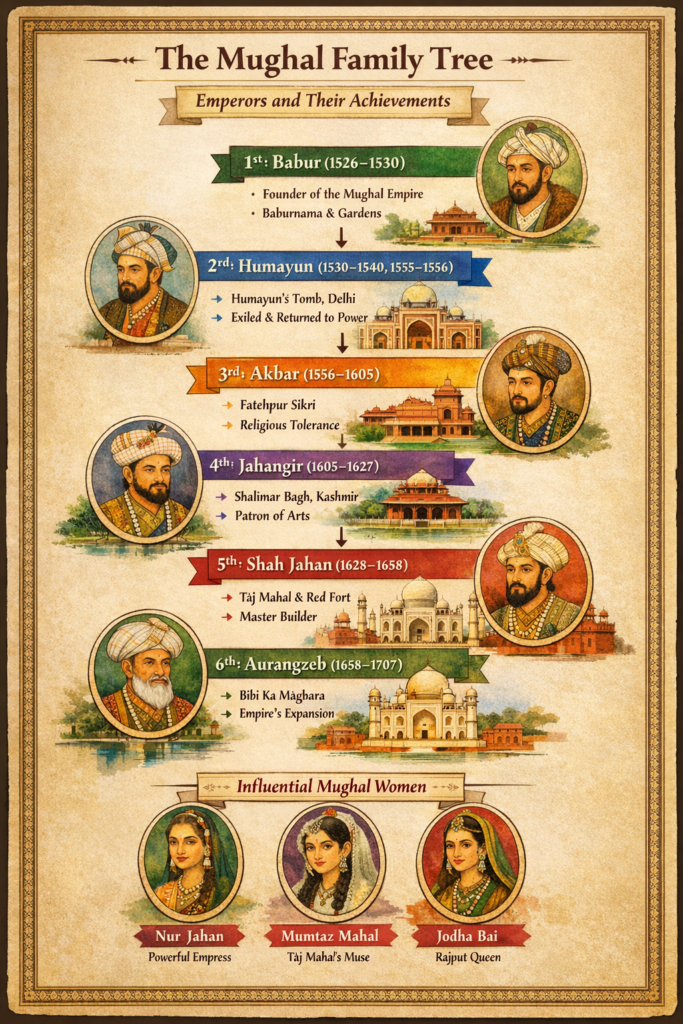
This lineage shows how the empire passed from father to son, each ruler leaving a unique legacy.
Conclusion
The Mughal family tree is more than just a list of emperors. It tells the story of ambition, culture, art, architecture, and governance that shaped India for centuries. From Babur’s conquests to Aurangzeb’s vast empire, the Mughals contributed to the arts, architecture, and cultural diversity that India is proud of today.
Disclaimer:
This article is for informational purposes only. Historical details are based on available sources and may vary.
About The Author