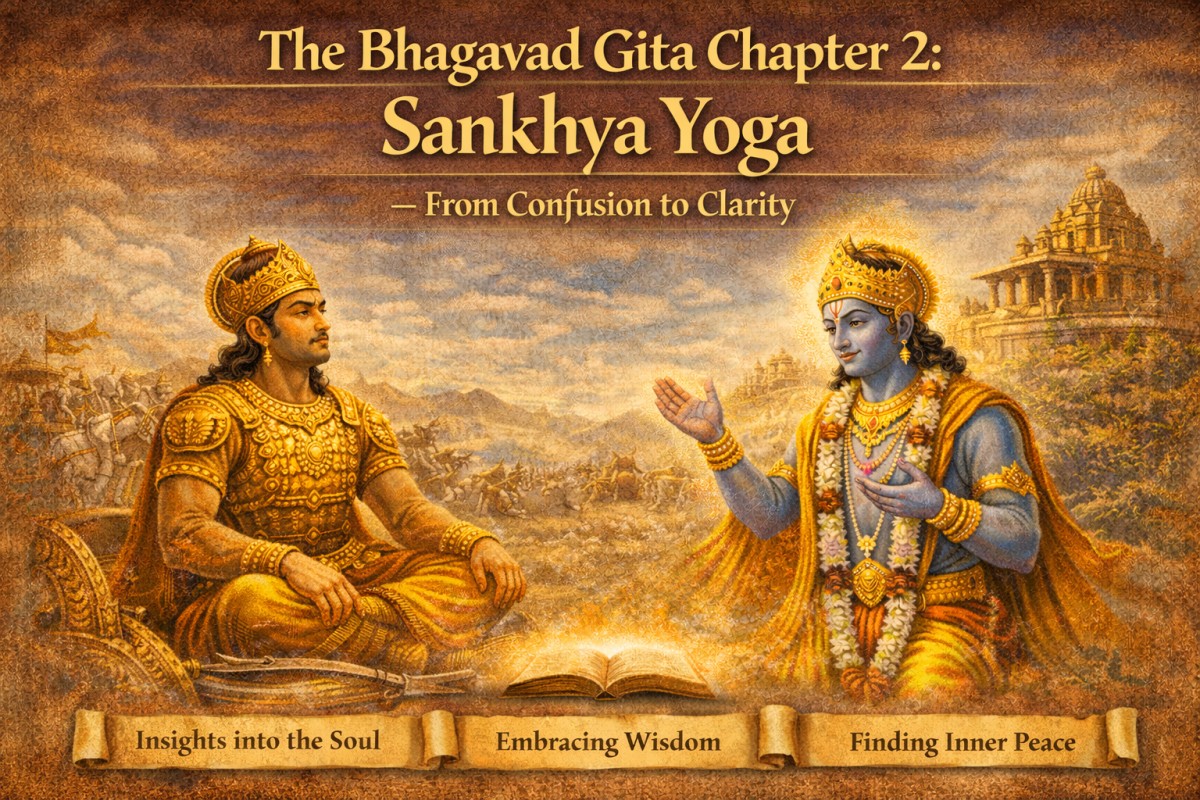
The Bhagavad Gita Chapter 2 Source - AI
When Arjuna was plunged in deep sorrow, with eyes blurred by tears, Lord Krishna began His teachings in Chapter 2, Sankhya Yoga. This chapter is the foundation of the Gita’s spiritual wisdom, where Krishna guides Arjuna through confusion and despair to clarity and strength.
Krishna’s First Words of Wisdom
Krishna asks Arjuna, “Whence has this mental dejection taken hold of you, in this critical situation? This weakness is shameful and will not lead you to heaven.” He urges Arjuna to cast off this weakness of heart and arise as the scorcher of enemies, reminding him of his duty as a warrior.
Arjuna’s Dilemma
Arjuna expresses his confusion: “Bhishma and Drona are my teachers, how can I fight them? It would be better to live on alms than to kill these noble souls. If I slay them, even victory will be stained with their blood.” He admits he does not know what is right and seeks Krishna’s guidance, saying, “I am your disciple; I take refuge in you.” Arjuna’s grief is so intense that he declares, “I will not fight,” and falls silent.
Krishna’s Teachings on the Soul
Krishna teaches that the soul(Atma) never dies. Our body keeps changing with time, but the soul always remains the same. Just like we throw away old clothes and wear new ones, in the same way, the soul leaves one body and enters another. Because of this, death is not the end of life, it is only a change of the body.
Krishna explains that we should not be too sad about death or too attached to life, because the soul is beyond birth and death. Happiness and pain are also temporary; they come and go. A person who learns to face both good and bad situations calmly and stays balanced in every condition is truly wise and strong.
Duty and Righteous Action
Krishna reminds Arjuna that as a Kshatriya, his duty is to fight for justice. Avoiding this righteous war would bring dishonor and sin. “If you are killed in battle, you will go to heaven; if you win, you will enjoy the earth. Arise, O son of Kunti, resolved to fight.” Krishna teaches that one should act with an equal mind in pain and pleasure, gain and loss, victory and defeat. This equanimity is the essence of Yoga.
Nishkama Karma: Action Without Attachment
Krishna teaches the path of Nishkama Karma, which means doing our work without thinking too much about the result. He explains that we have control over our actions, but not over what we will get in return. So, we should focus on doing our duty honestly and with full effort, without worrying about success or failure.
When a person works without attachment to results, the mind becomes calm and peaceful. Such a person does not get disturbed by loss or success. Krishna says that a wise person slowly becomes free from desire, fear, and anger. By staying balanced in every situation and not getting carried away by emotions, one can live a peaceful and steady life.
The Path to Peace
Krishna explains that true peace comes when we control our senses and desires. He gives a simple example: just like a tortoise pulls its legs inside its shell when there is danger, a wise person pulls the mind and senses away from harmful desires. When we stop running after every pleasure, the mind slowly becomes calm.
Krishna says that a person who controls desires finds peace, and from peace comes real and lasting happiness. When we live without too many wants, without ego, and without thinking “this is mine,” the mind becomes free. Such a person feels close to the truth of life and experiences deep peace.
Conclusion:
Chapter 2 of the Bhagavad Gita is a powerful guide for anyone facing confusion, sorrow, or difficult choices. Through Krishna’s teachings, Arjuna learns about the eternal soul, the importance of duty, and the wisdom of acting without attachment. This chapter encourages readers to face life’s challenges with courage, clarity, and inner peace. By understanding the principles of Sankhya Yoga, one can transform their perspective and find lasting happiness in any situation.
Also Read: The Bhagavad Gita Chapter 1: Arjuna Vishada Yoga – The Story of Confusion and Its Deep Life Lessons
Disclaimer:
This content is for general informational purposes about spiritual teachings in India and worldwide. It is not professional or personal advice. For guidance, consult authentic sources or qualified spiritual teachers.
About The Author