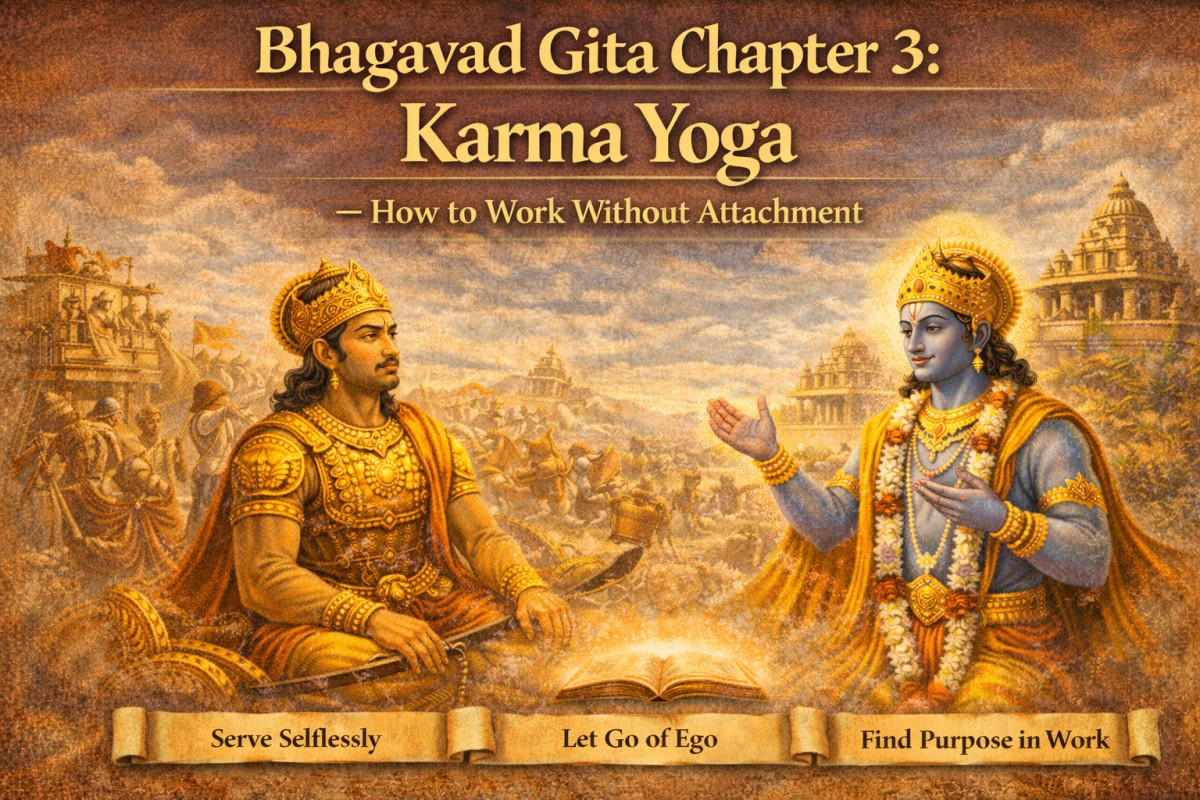
Bhagavad Gita Chapter 3: Karma Yoga Source- AI
In Chapter 3 of the Bhagavad Gita, Lord Krishna introduces Arjuna to Karma Yoga, the path of selfless action. Arjuna is confused: if knowledge is superior, why should he fight? Krishna explains that there are two paths, Jnana Yoga (path of knowledge) and Karma Yoga (path of action). Both are important, and everyone must act, as no one can remain inactive even for a moment. Even if someone tries to do nothing, nature forces them to act.
The Need for Action
Krishna says that simply sitting and thinking about spiritual things while ignoring action is not true yoga. A real yogi controls the senses with the mind and performs actions without attachment. The best person is one who works for the sake of duty, not for personal gain. Doing prescribed duties is better than inaction because even our body needs action to survive.
The Importance of Sacrifice
Krishna teaches that all actions should be done as a sacrifice (yajna). When we work for the benefit of others and offer the fruits of our work, we help the world. The creator Brahma said that mankind should act and sacrifice so that everyone can prosper. When we nourish the gods through sacrifice, they nourish us in return. Those who enjoy things without offering them in sacrifice are like thieves.
The Cycle of Action
Krishna explains that everything is connected: beings are born of food, food comes from rain, rain comes from yajna, yajna comes from action, and action comes from the Vedas, which are born from the Supreme Being. If we break this cycle, we harm ourselves and the world. The one who is content in the self and finds happiness within does not need to do any work for personal gain.
How to Work Without Attachment
Krishna says that we should do our duty well, but without attachment to the results. King Janaka and other great people became perfect by acting selflessly. We should also work for the welfare of others, not just for ourselves. Great people set examples for others to follow. Krishna himself works for the good of the world, even though he has nothing to gain.
The Wise Act Without Attachment
The wise person acts without attachment, while the ignorant work for personal gain. The wise do not disturb the minds of those who are attached to action. Instead, they set an example by acting with equanimity. Actions are performed by the qualities of nature, but the ego thinks, “I am the doer.” The wise know that the Supreme Self is not affected by actions.
Overcoming Desire and Anger
Krishna tells Arjuna that desire and anger are the enemies of wisdom. Desire is born of the impulse to act and can destroy knowledge. The senses, mind, and intellect are the seat of desire. To overcome desire, one must control the senses and mind. The wise person knows that the senses are inferior to the mind, the mind is inferior to the intellect, and the intellect is inferior to the Supreme Self.
Conclusion
Chapter 3 of the Bhagavad Gita teaches us that we must act in life, but we should do so without attachment to the results. By working selflessly and offering our actions as a sacrifice, we can achieve peace and happiness. Krishna’s teachings encourage us to control our senses and mind, overcome desire and anger, and act for the welfare of others
Disclaimer:
This content is for general informational purposes about spiritual teachings in India and worldwide. It is not professional or personal advice. For guidance, consult authentic sources or qualified spiritual teachers.
About The Author